

Best Calming Spray for Dog Grooming: 2026 Review
Table of Contents
- What the Best Calming Spray for Dog Grooming Actually Does
- How to Calm a Dog for Grooming: A Step-by-Step Routine
- Calming Sprays vs. Diffusers: Which Tool Fits Your Setup?
- Grooming Anxiety in Dogs: Spotting Stress Triggers Before the Session
- Application Techniques Groomers Use (That Owners Miss)
- Safety First: Ingredient Toxicity Warnings and Breed Considerations
- Building a Calm Grooming Kit: Product Picks and Pricing
- Conclusion
- Frequently Asked Questions
Last Updated: September 11, 2026
What the Best Calming Spray for Dog Grooming Actually Does
The best calming spray for dog grooming does two jobs: it reduces stress-induced behavior during handling and improves coat condition so the session ends faster. This review breaks down what the research supports and which products earn a place in your kit.
The global pet calming products market is projected to reach $19.1 billion in 2026, growing at 6.6% annually through 2033, according to Grand View Research's pet calming products market report. That spending reflects a real problem. Grooming anxiety in dogs is one of the most common reasons owners delay appointments or abandon home maintenance entirely.
A calming spray for dog grooming is a topical product, typically pheromone-based or plant-based, applied to the coat, towel, or brush before handling to reduce anxiety-driven behaviors and support coat conditioning during the session.
Most guides get this wrong: calming sprays aren't sedatives. They work on the biological response to stress triggers, not consciousness, a distinction that matters when choosing between a pheromone diffuser, a natural essential oil blend, and a finishing spray.
Pheromones vs. Natural Ingredients: What the Research Says
Pheromone-based products have the stronger evidence base. Five peer-reviewed clinical studies show that synthetic pheromone diffusers and sprays significantly reduce anxiety-driven behaviors such as pacing, according to Omni Pet's review of calming product efficacy. One widely cited study documented 111 citations supporting dog-appeasing pheromone (DAP) for reducing separation-induced anxiety and distress, per the National Center for Biotechnology Information study on DAP efficacy.
Natural options work differently. Plant-based formulas lean on ingredients like aloe vera and evening primrose for a soothing effect during bathing, a trend 2026 grooming guides emphasize heavily. The catch: the American Kennel Club's guidance on calming diffusers and sprays warns that some essential oils, including peppermint, are toxic to dogs. Efficacy also varies. Calming products help some dogs, not all of them.
How to Calm a Dog for Grooming: A Step-by-Step Routine
A consistent pre-grooming routine does more for grooming anxiety in dogs than any single product. Spray alone won't fix a dog that fears the table.
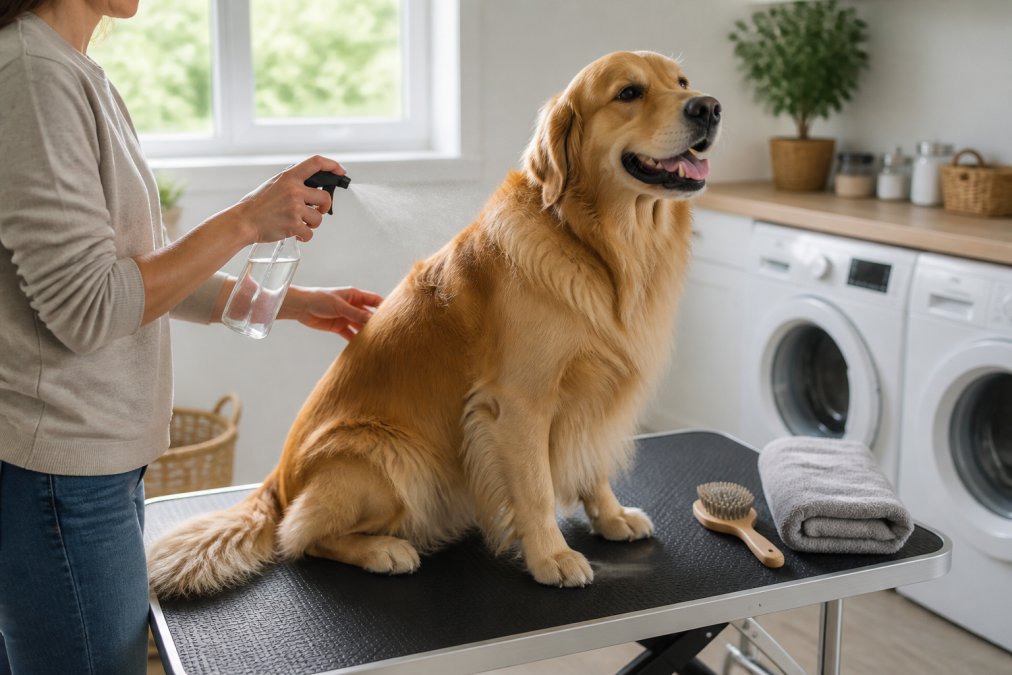
- Exercise first. A 15-minute walk burns off nervous energy before you start.
- Set up before you bring the dog in. Clippers, brushes, and towels within reach. Fumbling reads as tension.
- Apply calming spray 30 minutes ahead. Applying calming spray 30 minutes before the session, paired with a calm demeanor, can be effective on anxious dogs.
- Start with touch, not tools. Run your hands over paws and ears before any brush touches the coat.
- Work in short blocks. Five minutes of grooming, then a break. Repeat.
- Pair every tool with a treat. This is desensitization and positive reinforcement working together.
- End on a win. Stop while the dog is still calm, even if the job isn't perfect.
Calming Sprays vs. Diffusers: Which Tool Fits Your Setup?
Diffusers win for background anxiety; sprays win for the grooming session itself.
| Feature | Calming Spray | Pheromone Diffuser |
|---|---|---|
| Onset | Minutes | Hours to days |
| Best for | Grooming sessions, travel, vet visits | Ongoing home anxiety |
| Coverage | Direct, localized | Room-wide |
| Portability | Yes | No, plug-in |
| Duration per use | Single session | Continuous, 30-day refills |
| Cost model | Per-bottle | Per-refill subscription |
A diffuser helps in the room where you groom but can't follow your dog to the table; a spray can. The practical setup is both: a diffuser running in the background and a spray for the session.
Grooming Anxiety in Dogs: Spotting Stress Triggers Before the Session
Stress triggers show up before the clippers do. Reading them is the difference between a five-minute session and a wrestling match.
Watch for these early signals:
- Lip licking and yawning when no food is present
- Whale eye, where the whites of the eyes show
- Tail tucked or stiff, not wagging
- Paw lifting as you reach for a tool
- Sudden stillness after previously moving freely
The trigger is often environmental, not the tool itself: a running dryer, a slick floor, or clippers in another room can all set off stress-induced behavior. Owners who track these patterns usually find one or two repeat offenders.
Application Techniques Groomers Use (That Owners Miss)
Most reviews treat application as an afterthought: spray the dog, brush the dog, done. Professional groomers treat it as a sequence, because a calming spray layered wrong either burns off before the clippers come out or interferes with products applied on top of it.
The layering order matters more than the bottle
Calming spray isn't a standalone step. It sits inside a stack of products, and the order determines how much spray actually reaches the coat.
- Shake the bottle. Pheromone and plant-based formulas separate. An unshaken bottle delivers an inconsistent dose from the first spray to the last.
- Apply to dry, unwashed coat first. Spray on a wet coat dilutes the active and rinses down the drain. If you are bathing, the calming spray goes on after the bath and after the coat is towel-dried, not before.
- Mist your palms and forearms, not the dog. This distributes product evenly and desensitizes the dog to handling before the brush arrives.
- Work hands through the coat in slow, circular motions for about 30 seconds, starting at the back and moving toward the flanks.
- Mist the brush, not the dog, then work the least sensitive areas first: back, flanks, legs, paws.
- If you are drying, reapply to the towel. Heat and friction burn off pheromone and plant-based actives faster than anything else in the session.
Coat-type compatibility: the variable nobody tests for
A spray that works on a short-coated beagle can mat a double-coated husky or sit greasy on a curly-coated poodle. Coat type changes how the product behaves, and most reviews ignore this.
- Short, smooth coats (beagles, boxers, dachshunds). Product sits on the surface and absorbs quickly. Light misting is enough; over-application leaves a visible film.
- Double coats (huskies, shepherds, akitas). The undercoat traps product. Mist the brush and work with the grain, then follow with a slicker to lift the undercoat. Never soak the coat, trapped moisture under a double coat is a skin problem waiting to happen.
- Curly and wool coats (poodles, bichons, doodles). These coats hold product and can mat if the spray is worked in unevenly. Apply to the brush in small amounts and detangle before you spray, not after.
- Wire and rough coats (terriers, schnauzers). Minimal product, applied to the brush only. These coats are prone to looking greasy fast.
What "professional-grade" actually means here
The gap between a $30 bottle and a $15 bottle is smaller than the gap between a $15 bottle applied correctly and a $30 bottle applied wrong. Groomers who work with anxious dogs report that technique, layering order, coat-type adjustment, and pre-handling desensitization, accounts for more of the outcome than the brand on the shelf. That part is free to fix.
Safety First: Ingredient Toxicity Warnings and Breed Considerations
Not every calming product is safe for every dog, and the "natural" label tells you almost nothing about whether a spray belongs on your dog's coat. The American Kennel Club flags certain essential oils as dangerous to dogs, and that warning applies to grooming sprays that list them without a toxicity check.
Safe vs. toxic essential oils: a usable breakdown
Most warnings list a handful of oils and stop. What actually matters is not just which oil, but the concentration, the route of exposure, and the size of the dog.
Oils commonly considered risky in topical dog products:
- Peppermint and wintergreen. Contain compounds that dogs metabolize poorly. Even small topical amounts can cause drooling, vomiting, or wobbliness in small dogs.
- Tea tree (melaleuca). Toxic at concentrations that are easy to reach in undiluted grooming sprays. Signs of trouble include lethargy and loss of coordination.
- Eucalyptus. A respiratory irritant, especially for flat-faced breeds that already struggle to breathe efficiently.
- Citrus oils (lemon, lime, orange, grapefruit). Can cause skin irritation and, in larger amounts, gastrointestinal upset.
- Cinnamon, clove, and other "hot" oils. Skin irritants on contact, and worse on broken or irritated skin.
Oils more commonly used in dog-safe formulas (still concentration-dependent):
- Lavender and chamomile in properly diluted form
- Valerian root and passionflower extracts
- Aloe vera and evening primrose for skin-soothing rather than sedation
The sensory-overload problem nobody talks about
Dogs have roughly 10,000 to 100,000 times the olfactory sensitivity of humans, depending on breed. A fragrance that reads as "light lavender" to you can be an overwhelming wall of scent to a dog already in a high-stress grooming session, the reason some dogs seem to get more anxious after a spray is applied.
The practical rule: if you can smell the spray strongly from a few feet away, it's probably too much. Apply to the brush or your hands, work it in, and let the scent dissipate for a minute before handling. Scent-sensitive breeds, beagles, bloodhounds, and other scent hounds, may do better with an unscented pheromone formula than any essential-oil blend.
Breed and health considerations
- Flat-faced breeds (pugs, French bulldogs, Boston terriers). Overheat easily and are more sensitive to stress during handling. Skip eucalyptus and any strong respiratory irritant.
- Double-coated breeds. Need product that will not mat the undercoat. Greasy or heavy formulas trap debris and moisture against the skin.
- Small breeds and puppies. Lower body weight means a smaller margin before a topical oil becomes a systemic problem. Dilute further or skip essential-oil products entirely.
- Dogs with seizure history. Skip essential-oil-based sprays altogether and ask your veterinarian before using any pheromone product. A calming aid that triggers a medical event is worse than no aid at all.
- Dogs with dry, irritated, or broken skin. Avoid alcohol-based formulas, which sting on contact and strip the skin barrier further.
What to look for on the label
- A disclosed ingredient list, not just "fragrance" or "proprietary blend"
- A stated dilution or concentration for any essential oil
- A pheromone-based option if your dog is scent-sensitive
- A veterinarian or veterinary behaviorist endorsement, not just a grooming-brand logo
If a product hides its ingredient list, that is the red flag. Everything else is a judgment call you can make with your veterinarian.
Building a Calm Grooming Kit: Product Picks and Pricing
A complete grooming kit for anxious dogs runs under $100 when you buy the pieces that matter. Here's what Pets R Smarter stocks that fits the job.
| Product | Price | Best For |
|---|---|---|
| Gentle Pet Skin Care Liquid | $19.99 | Soothing skin between sessions |
| Bodhi Dog Shampoo Brush | $17.25 | Bath-time scrubbing, wet or dry |
| Slicker Grooming Brush | $14.99 | Daily coat maintenance |
| Dog & Cat Nail Clipper | $12.50 | Nail trims between pro visits |
| Earth Rated Dog Wipes | $9.98 | Quick cleanups, alcohol-free |
| Pet Grooming & Flea Removal Tool Set | $27.99 | Full routine coverage, 30 pieces |
The Gentle Pet Skin Care Liquid is the piece most owners skip and later wish they hadn't. A 0.7 fl oz bottle lasts several sessions and helps calm irritated skin between appointments, useful for dogs whose anxiety shows up as licking or scratching.
The Bodhi brush is the sleeper pick: flexible rubber bristles work wet or dry, and the loop handle gives you control when a nervous dog shifts mid-stroke.
Conclusion
Grooming anxiety doesn't disappear because you bought the right bottle. It fades when routine, tools, and products all point the same direction.
Pets R Smarter built its catalog around that idea. Every product is chosen with expert input, backed by the Tail Satisfaction Guarantee, and stocked for owners who want high-quality care. Start with the Gentle Pet Skin Care Liquid and the Bodhi Dog Shampoo Brush, pair them with a consistent pre-grooming routine, and give your dog a session that ends calm instead of chaotic.
Frequently Asked Questions
What do professional groomers use to calm dogs during sessions?
Many professional groomers use pheromone-based sprays, such as dog-appeasing pheromone (DAP) products, about 30 minutes before a session. Research from the National Center for Biotechnology Information shows DAP can significantly reduce separation-induced anxiety and distress. Some groomers pair the spray with a calm demeanor and low-stress handling. For natural options, plant-based sprays with ingredients like aloe vera are also popular. Always test a small area first and watch for any adverse reaction.
Are pheromone-based calming sprays safe for all dog breeds?
Pheromone-based sprays are generally considered safe for most breeds, but the American Kennel Club notes that calming products work on some dogs, not all. There is no breed-specific restriction, but individual sensitivity varies. Puppies, seniors, and dogs with respiratory conditions may need a veterinarian's approval before use. Always check the label for alcohol-free and hypoallergenic formulas, and avoid sprays with essential oils like peppermint, which can be toxic to dogs.
How long does the effect of a calming grooming spray last?
Most calming sprays last between 1 and 4 hours, depending on the formula and the dog's metabolism. Pheromone-based sprays tend to work within 15 to 30 minutes and can last through a typical grooming session. For longer sessions, you may need to reapply. The effect also depends on the level of stress; highly anxious dogs may need additional calming methods like a quiet environment or a pre-grooming walk. Always follow the product's reapplication guidelines.
Can I use calming sprays on puppies during their first grooming?
Yes, but with caution. Puppies can benefit from calming sprays to make early grooming positive, but their senses are more sensitive. Choose an alcohol-free, hypoallergenic formula and spray it on a brush or your hands rather than directly on the puppy. Introduce the scent gradually and pair it with treats and praise. If your puppy shows signs of distress, stop and try again later. For very young puppies, consult your veterinarian before using any calming product.
What is the difference between a calming spray and a finishing spray?
A calming spray is designed to reduce anxiety using pheromones or natural relaxants, while a finishing spray is a grooming product that adds shine, detangles, or leaves a pleasant scent. Some products combine both functions, offering stress relief and coat conditioning. When choosing, check the label for calming ingredients like L-theanine or melatonin versus cosmetic ingredients like silicone or essential oils. For grooming sessions, a dual-purpose spray can save time, but always prioritize your dog's safety and comfort.