

Best Dog Clipper Attachments for Different Coat Types
Table of Contents
- Why Attachment Choice Depends on Coat Type
- Dog Coat Types and Grooming Tools: A Quick Reference
- Dog Grooming Clipper Blade Sizes: Decoding the Numbers
- How to Use Guard Combs on Dogs (Snap-On vs. 5-in-1)
- Blade Heat, Sanitization, and Track Marks: What Most Guides Skip
- Matching the Best Dog Clipper Attachments to Dense, Curly, and Sensitive Coats
- Maintenance That Keeps Attachments Cutting Clean
- Frequently Asked Questions
Last Updated: September 25, 2026
Why Attachment Choice Depends on Coat Type
The best dog clipper attachments for different coat types come down to one variable: how the blade meets the hair. A double, curly, or silky coat each demands a different cutting approach, and the wrong attachment is the fastest route to a botched trim, clipper burn, or a dog that fights the process.
Dog Coat Types and Grooming Tools: A Quick Reference
Dog coat type is the biggest factor in attachment selection: density, texture, and shedding behavior determine which blade cuts cleanly without snagging. Five categories cover most breeds.
Double, Curly, Silky, Wire, and Smooth Coats
- Double coats (Husky, Golden Retriever): dense undercoat plus a longer topcoat. These need heavy-duty clippers and a skip-tooth blade to get through the undercoat.
- Curly coats (Poodle, Bichon): tightly curled, continuously growing, and prone to matting. A full-tooth blade plus a guard comb keeps curls even.
- Silky coats (Yorkie, Shih Tzu): fine, long, and tangle-prone. A finishing blade or larger guard comb prevents pulling.
- Wire coats (Schnauzer, Terrier): coarse and stiff. A medium blade with a snap-on comb handles the texture.
- Smooth coats (Beagle, Boxer): short and low-maintenance. A fine blade or #10 blade works for touch-ups.
All Groom's clipper coat type guide notes that thick, double, mixed-texture, non-shed, wool, fleece, wire, and knot-prone coats require heavy or super-duty clippers, since attachment compatibility depends on motor capacity.
Dog Grooming Clipper Blade Sizes: Decoding the Numbers
Clipper blade size works on an inverse scale: the higher the number, the shorter the cut. A #10 blade leaves about 1.5 mm of coat, while a #40 leaves roughly 0.5 mm. This scale is the most common source of home-grooming mistakes, because owners assume a bigger number means a bigger cut.
| Blade Size | Cutting Length | Best For |
|---|---|---|
| #40 | ~0.5 mm | Surgical prep, mat removal under a guard, paw pads |
| #30 | ~0.8 mm | Close work on pads and sanitary areas |
| #15 | ~1.2 mm | Tight trims, poodle feet, face |
| #10 | ~1.5 mm | Pads, sanitary trims, smooth coats |
| #9 | ~2 mm | Short full-body clips |
| #7F | ~3.2 mm | Full-body clips on smooth and silky coats |
| #5F | ~6.4 mm | Double coats, moderate length |
| #4F | ~9.5 mm | Thick coats needing more leave-behind |
| #3F | ~13 mm | Coarse wire coats |
What the "F" Means (and Why It Matters)
The letter F stands for "finish." A finish blade has finer teeth and a smoother cutting edge than the same-numbered non-finish blade, leaving a cleaner surface and fewer track marks. A #7F and a #7 cut to the same length, but the F version is the one you want for visible body work. Non-F blades are reserved for pre-clipping matted or very dirty coats, where finish does not matter and you do not want to dull your good blade.
Skip-Tooth vs. Full-Tooth Blades
Skip-tooth blades have gaps between the teeth, letting them feed dense undercoat through without jamming, the right choice for double coats and heavy shedding. Full-tooth blades cut more evenly and leave a smoother finish, suiting curly, silky, and smooth coats where a clean line matters more than bulk removal.
Blade Choice Is a Motor Decision, Not Just a Length Decision
- Smooth and silky coats: any standard detachable-blade clipper handles a #10 through #4F without strain.
- Curly and fleece coats: a multi-speed clipper lets you run slower on mats and faster on the body, keeping the blade from grabbing.
- Double coats: a heavy-duty corded clipper is the safe pairing for a #5F or #4F skip-tooth. Cordless consumer clippers will cut, but slow down and heat up on a full Husky.
- Wire coats: a #4F full-tooth with a snap-on comb gives the length control hand-stripping would otherwise provide.
All Groom's clipper coat type guide notes that thick, double, mixed-texture, non-shed, wool, fleece, wire, and knot-prone coats require heavy or super-duty clippers, since attachment compatibility depends on motor capacity.
How to Use Guard Combs on Dogs (Snap-On vs. 5-in-1)
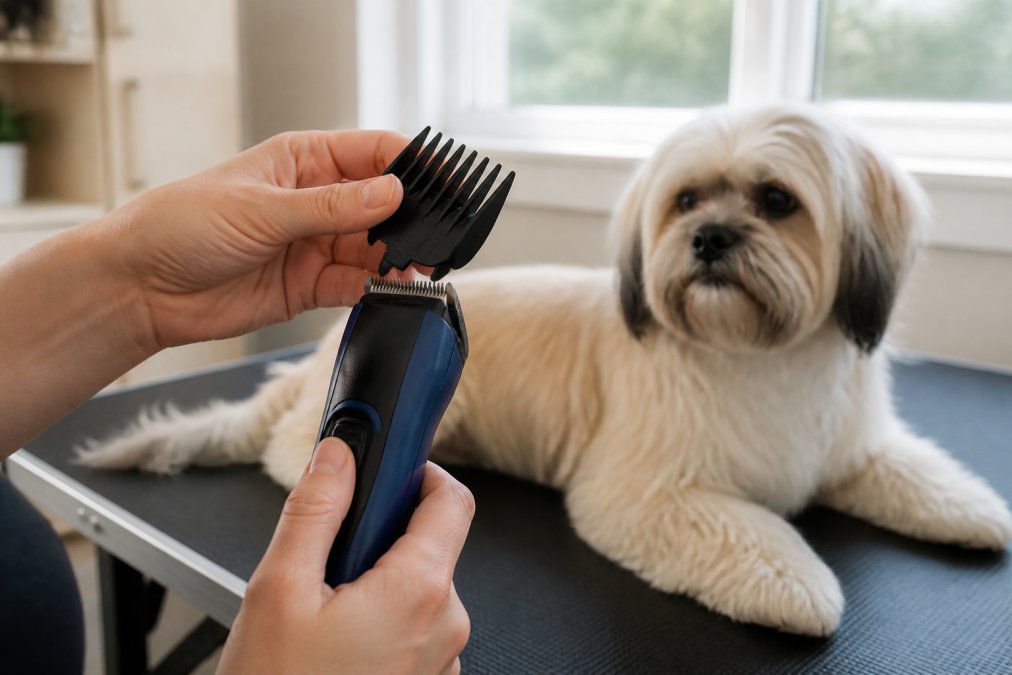
Learning how to use guard combs on dogs starts with identifying which system your clipper uses, because snap-on and 5-in-1 combs are not interchangeable. Snap-on combs fit standard detachable blade clippers and slide over the blade; the 5-in-1 system uses a single adjustable blade with a built-in length dial.
Blade Heat, Sanitization, and Track Marks: What Most Guides Skip
Blade heat is the most underrated problem in home grooming. Friction builds fast, and a hot blade causes clipper burn and makes dogs flinch. Coolant spray and a spare blade let you rotate mid-groom.
Matching the Best Dog Clipper Attachments to Dense, Curly, and Sensitive Coats
The best dog clipper attachments for different coat types are not one universal comb. Match by density first, texture second, and skin sensitivity third.
Pet Grooming & Flea Removal Tool Set →
| Coat Type | Blade | Comb | Clipper Type |
|---|---|---|---|
| Double | Skip-tooth #5F | Rarely needed | Heavy-duty corded |
| Curly | Full-tooth #10 | Snap-on guard | Cordless, multi-speed |
| Silky | Finishing #7F | Larger guard comb | Cordless |
| Wire | Full-tooth #4F | Snap-on comb | Corded |
| Smooth | Fine #10 | Not needed | Either |
Maintenance That Keeps Attachments Cutting Clean
Clipper maintenance determines how long attachments stay sharp, and how cool they run. Oiling is heat management, and heat is what kills blades, irritates skin, and produces the uneven cuts that send home groomers back to the pet store.
Why Heat Is the Real Enemy
Every stroke of the blade against hair generates friction, and friction generates heat. A dull blade has a rounded cutting edge, so it rubs rather than shears, multiplying friction and heat. A dry blade adds metal-on-metal friction at the drive point. Within minutes on a dense coat, an unlubricated blade can reach a temperature that is uncomfortable against skin and accelerates wear on the cutting edge.
The Between-Session Routine
- Oil before every use. Two drops of purpose-made clipper oil across the blade edge and one drop at the drive point. Do not substitute WD-40, cooking oil, or mineral oil, they evaporate too fast, gum up, or attract grit.
- Brush out trapped hair after every session. Hair packed behind the blade insulates it and forces the motor to work harder next run. A small stiff brush is enough.
- Coolant spray between passes on long grooms. Coolant spray is a heat sink, not a lubricant. Use it on the blade, not the clipper body, and let it flash off before resuming.
- Rotate blades on long grooms. Two identical blades used alternately each run cooler than one used continuously, and the pair outlasts a single blade by a wide margin.
- Store dry. Moisture in a closed case rusts blades. Wipe, air-dry, then store.
Sanitization Between Dogs
If you groom more than one pet, or groom at a shelter, rescue, or friend's house, sanitization is not optional. Blade surfaces can carry dander, yeast, bacteria, and sometimes ringworm spores between animals. A wipe-down with a pet-safe disinfectant (or a 1:10 bleach solution followed by a rinse and re-oil) between dogs prevents cross-contamination and the skin irritation owners often mistake for an allergy.
Troubleshooting Track Marks
Track marks, the visible lines a blade leaves behind, are the most common complaint from first-time home groomers, and they almost always trace to one of three technique errors rather than a bad blade:
- Moving too slowly. The blade dwells in one spot, cuts deeper, and leaves a ridge at the edge of the pass. Keep the clipper moving in long, overlapping strokes at a steady pace.
- Pressing too hard. Pressure does not make the blade cut better; it makes it cut hotter and dig in. Use light, even contact.
- Using a dull or dry blade. A blade that is not shearing cleanly will skip and leave lines no matter how good your technique is. If track marks appear mid-groom, stop and oil or swap the blade.
The Tools Around the Clipper
The tools around the clipper need care too. The Bodhi Dog Shampoo Brush at $16.62 lifts loose fur during bathing, and the Protective Pet Handling Gloves at $15.25 add a barrier against ordinary scratches and light contact during supervised care. These gloves are not bite-proof and cannot prevent every injury, so supervise closely.
A sharp, oiled, cool blade with the right attachment cuts faster and cleaner than a dull, dry, hot blade with the wrong one. Maintenance is not separate from attachment choice; it is what makes the attachment choice actually work.
Frequently Asked Questions
What is the difference between clipper blades and guard combs?
Blades do the actual cutting and set the base length, while guard combs snap over a blade to leave hair longer. A #10 blade cuts very close to the skin, but add a 1/2-inch guard comb and you get a longer, softer finish. Most home groomers keep one or two cutting blades plus a set of guard combs in different lengths. Detachable blade systems make swapping between the two faster and easier to clean between dogs.
How do I choose the right clipper attachment for my dog's hair length?
Start with the look you want, not the attachment. For a close summer trim on a smooth coat, a #10 or #7F blade works well. For a longer teddy-bear finish on a curly or fleece coat, use a #10 blade with a 1/2-inch or 5/8-inch guard comb. For thick double coats, a skip-tooth blade or a heavy-duty clipper with a matched comb handles the density better than a standard setup.
Can I use plastic clipper attachments on all dog coat types?
No. Plastic guard combs work fine on fine, silky, or smooth coats, but they can snag or bend on dense double coats, heavy mats, or thick curly fur. For those coats, metal snap-on combs or a dedicated skip-tooth blade hold up better. Check that the comb is rated for your clipper's motor capacity, since a weak motor paired with a long plastic comb will pull hair instead of cutting it.
Do clipper guard combs work on matted dog fur?
Guard combs do not cut through mats, and forcing them can pull skin and cause injury. Mats need to be removed first with a detachable blade, often a #10 or #7F, worked in short passes. If the matting is tight against the skin or covers a large area, a veterinarian or professional groomer should handle it. Trying to clip over mats at home is one of the most common causes of nicks and clipper burn.