

6 Best Grooming Tools for Anxious Dogs (2026 Picks)
Table of Contents
- Why Grooming Tools for Anxious Dogs Need a Behavior-First Design
- How We Selected These 6 Grooming Tools for Anxious Dogs
-
The 6 Best Grooming Tools for Anxious Dogs
- 1. Slicker Grooming Brush: Gentle Detangling for Sensitive Skin
- 2. Dog & Cat Deshedding Grooming Brush: Low-Noise Undercoat Care
- 3. Dog & Cat Nail Clipper: Precise, Scissor-Style Trims
- 4. Bodhi Dog Shampoo Brush: Calming Massage During Baths
- 5. Silicone Slow-Feeding Lick Mat: Positive Distraction Tool
- 6. Plush Donut Calming Pet Bed: A Safe Space for Recovery
- What to Look For in the Best Professional Grade Dog Clippers
- Desensitization Techniques for Dog Grooming: A Step-by-Step Plan
- Creating a Calm Grooming Environment: Setup and Safety
- Which Grooming Tool Should You Pick First?
- Conclusion: Build a Stress-Free Grooming Routine
- Frequently Asked Questions
Last Updated: September 7, 2026
Why Grooming Tools for Anxious Dogs Need a Behavior-First Design
Grooming is essential, yet for many dogs it triggers a fight-or-flight response. The right grooming tools for anxious dogs respect the animal's sensory limits and build trust over time.
Behavioral management through specific tool selection is paramount for animals with anxiety or reactivity, according to research on grooming-related concerns among companion animals. The global pet grooming market now values this approach at USD 19.5 billion in 2026, with quiet trimmers and ergonomic designs driving growth Future Market Insights pet grooming report. Below, we'll show you exactly how to choose tools that calm rather than trigger, based on the sensory profile of your dog.
Quick Picks:
- Best Overall: Slicker Grooming Brush, gentle detangling for daily use
- Best for Deshedding: Dog & Cat Deshedding Grooming Brush, low-noise undercoat care
- Best Calming Aid: Silicone Slow-Feeding Lick Mat, positive distraction during trims
How We Selected These 6 Grooming Tools for Anxious Dogs
Most guides group tools by coat type or price point. We grouped them by the sensory trigger each tool addresses: tactile sensitivity, noise sensitivity, and restraint anxiety.
Tool selection must be tailored to coat type to minimize discomfort and anxiety during grooming, as documented in K9Sphere's tested brush guide. We prioritized whisper-quiet operation, vibration dampening, and soft-touch materials that support low-stress handling. Each pick below earned its place through professional-grade construction and a design that actively reduces grooming anxiety rather than simply getting the job done.
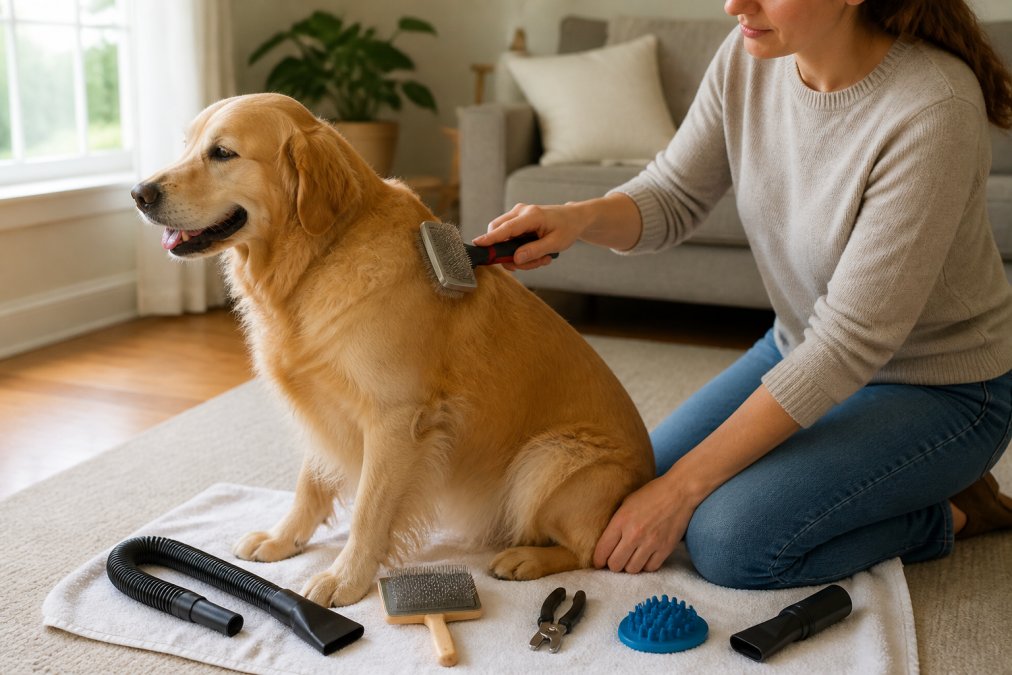
The 6 Best Grooming Tools for Anxious Dogs
1. Slicker Grooming Brush: Gentle Detangling for Sensitive Skin
The Slicker Grooming Brush for Dogs & Cats tops our list because it addresses tactile sensitivity head-on. Fine, angled bristles glide through mats without scraping the skin. At $14.99, it is the most affordable entry point for a positive grooming routine.
The bristles flex on contact, reducing the sharp pinpoint sensation that triggers flinching. For double coats, pair with an undercoat rake; for short-haired breeds, it works alone for weekly maintenance.
2. Dog & Cat Deshedding Grooming Brush: Low-Noise Undercoat Care
Shedding season spikes anxiety because loose undercoat pulls during brushing. The Dog & Cat Deshedding Grooming Brush removes that layer with a stainless steel edge that reaches the undercoat without scraping the topcoat. At $60.75, it suits double-coated breeds like Huskies and Golden Retrievers.
This tool cuts through the undercoat in smooth strokes rather than catching and pulling, reducing negative associations. Use once per week during heavy shedding, and follow with a soft-bristle brush to distribute natural oils.
3. Dog & Cat Nail Clipper: Precise, Scissor-Style Trims
Nail trimming is the most common source of grooming anxiety because a wrong cut causes pain. The Dog & Cat Nail Clipper uses a scissor-style stainless steel blade for precise control. At $12.50, it delivers outsized value for nervous dogs.
For dogs that panic at the sound of electric grinders, manual clippers are the safer, silent alternative for trimming around sensitive areas like eyes and paws We Love Doodles grooming tool analysis. The scissor mechanism produces no vibration and minimal noise, two triggers that send anxious dogs into reactive behavior.
4. Bodhi Dog Shampoo Brush: Calming Massage During Baths
Bath time combines water and restraint stressors. The Bodhi Dog Shampoo Brush transforms the experience into a massage with soft rubber bristles that lather soap while soothing the skin. At $17.51,
The rubber curry construction is gentler than coarse slicker brushes and works wet or dry. The massaging sensation releases tension and creates a positive association with bathing.
5. Silicone Slow-Feeding Lick Mat: Positive Distraction Tool
The Silicone Slow-Feeding Lick Mat is not a grooming tool in the traditional sense, yet it may be the most important item here. Licking releases calming endorphins, making it essential for counter-conditioning during nail trims or brushing. At $14.75, it offers outsized behavioral benefits.
Spread peanut butter or yogurt across the mat and attach it to a wall or tub edge. While your dog licks, you can perform grooming tasks that would otherwise trigger anxiety. This treat-based training builds positive associations through repeated pairing.
6. Plush Donut Calming Pet Bed: A Safe Space for Recovery
Post-grooming recovery is as important as the session itself. The Plush Donut Calming Pet Bed provides a safe space to decompress after a stressful grooming experience. At $31.99 in sizes from small to XL, the raised rim supports natural curling and creates security.
The plush faux-fur surface is washable, which matters when grooming sessions leave behind loose hair and debris. Place the bed in a quiet corner away from high-traffic areas, and consider pairing it with a pheromone diffuser to reinforce the calming environment Meadow Vista Veterinary Clinic recommendations.
What to Look For in the Best Professional Grade Dog Clippers
Most clipper guides stop at decibel ratings, but noise is only one of three sensory stressors. Vibration and heat are often the real culprits behind a dog that bolts at the sight of clippers. This section breaks down clipper selection by sensory trigger.
Noise: The Obvious Trigger
Noise sensitivity is the most recognized trigger. A dog's hearing extends to about 65,000 Hz, beyond the human limit of 20,000 Hz, so a high-frequency whine that sounds muffled to you can be piercing to your dog. Do not trust 'low noise' claims; hold the running clipper at your dog's ear height, 12 to 18 inches off the ground, and listen for any high-pitched whine.
Look for a decibel rating at or below 60 dB at the source. Rotary motors are quieter than pivot-drive motors but run hotter; prioritize a rotary motor with a separate cooling vent system.
Vibration: The Overlooked Tactile Stressor
Vibration is a tactile trigger independent of noise. A dog with acute tactile sensitivity, common in herding breeds, can find the buzzing sensation more distressing than the sound. This is why a quiet-sounding clipper can still cause panic.
Run the device against the back of your hand; if you feel a strong buzz, the dog feels it amplified. Look for vibration-dampening housing via rubberized grips or internal counterweights. Some premium models feature 'floating blade' technology, where the blade is suspended on micro-springs to absorb vibration before it reaches the skin, a significant advancement worth the higher price.
Heat: The Silent Burn Risk
Heat generation is the least discussed but most dangerous trigger. Metal blades generate friction heat quickly, especially on thick coats. A blade reaching 110°F can cause a low-grade burn, creating a lasting negative association, a primary reason a dog may suddenly become reactive after previously tolerating grooming.
Evaluate clippers for cool-running blade technology. Ceramic blades run cooler but are brittle; coated steel blades offer a balance of durability and heat dissipation. Regardless of material, plan a blade change or cool-down break every 10 to 15 minutes on a thick coat, and keep a spare blade to rotate.
Static Electricity: The Invisible Startle
Static electricity is a rarely mentioned but real trigger. Dry air, synthetic bristles, and rapid strokes can generate a charge that shocks when the blade touches the coat, a major setback for a nervous dog. Use a metal comb before clippering, consider a humidifier in winter, and mist a water-based grooming spray to reduce static.
The Sensory-Specific Clipper Checklist
| Sensory Trigger | What to Look For | Red Flag |
|---|---|---|
| Noise | Decibel rating ≤ 60 dB; rotary motor | High-pitched whine at ear height |
| Vibration | Vibration-dampening housing; floating blade | Strong buzz felt on back of hand |
| Heat | Ceramic or coated steel blades; cooling vents | Blade hot to the touch after 5 minutes |
| Static | Metal comb included; compatible with water-based sprays | Synthetic-only brush attachments |
By evaluating clippers through this sensory-specific lens, you can identify which trigger is causing your dog's panic and select a tool that addresses it directly, rather than buying another 'quiet' clipper that still fails because vibration or heat is the real issue.
Desensitization Techniques for Dog Grooming: A Step-by-Step Plan
Desensitization introduces a trigger at low intensity so the dog remains calm, then gradually increases exposure. These desensitization techniques for dog grooming rewire the emotional response to tools. The standard five-step approach misses two critical components: managing trigger stacking and building in post-session recovery. This plan incorporates both.
Understanding Trigger Stacking
Trigger stacking is the accumulation of low-level stressors that, individually, a dog might tolerate, but together push the dog over threshold. A dog might be fine with the sight of the brush, the sound of the clipper, and the feel of touch, but when all three happen together, the dog snaps. This is why a dog can be 'fine' during exercises but reactive in a real session.
To manage trigger stacking, introduce only one new element per session. If working on clipper desensitization, do not also introduce a new table, room, or treat. Keep everything else familiar, a principle most guides omit, yet often the difference between success and failure.
The Step-by-Step Protocol
This protocol assumes a dog that is fearful but not aggressive. If your dog shows aggression (growling, snapping, lunging), stop and consult a certified professional dog trainer or veterinary behaviorist.
-
Baseline assessment (Day 1-3). Identify your dog's specific trigger, sound, vibration, restraint, or sensation. Test each element in isolation. Turn on the clipper in another room, does your dog react? Touch the back with the clipper off, does your dog flinch? This baseline tells you where to start.
-
Threshold identification (Day 4-7). Find the distance or intensity at which your dog notices the trigger but shows no stress signals (panting, lip licking, whale eye, tucked tail). For a noise-sensitive dog, this might be the clipper in the next room; for a tactile-sensitive dog, the brush touching the floor nearby. Always start below this threshold.
-
Sub-threshold exposure (Week 2-3). Present the trigger at or below threshold. Reward calm behavior with high-value treats (chicken, cheese, or liver). Keep sessions to 3-5 minutes and end before the dog shows any stress, while still relaxed, not after becoming anxious.
-
Gradual intensity increase (Week 3-6). Increase intensity by one small step every 3-5 sessions, only if the dog remains calm. For noise, move the clipper closer by a foot; for tactile, touch the brush to the back for one second. If stress appears, drop back to the previous level for several sessions.
-
Functional pairing (Week 6+). Once the dog tolerates the tool at full intensity, pair it with a real, brief grooming action. One brush stroke, followed by a treat; two seconds of clipper contact on a non-sensitive area like the shoulder, followed by a treat. Gradually increase strokes or seconds per session.
Session Length and Frequency
Short, frequent sessions are far more effective than long, infrequent ones. A 5-minute daily session produces faster results than a 20-minute weekly one, because desensitization relies on repeated positive pairings and short sessions prevent reaching the stress threshold. Most practitioners find 3-5 minute sessions, 5-6 days per week, yield improvement within 3-4 weeks.
Post-Session Recovery: The Missing Step
What happens after the session is as important as what happens during it. A dog working near threshold needs time to decompress. Immediately after, move the dog to a quiet, safe space, a crate with a blanket or a quiet room, and allow rest undisturbed for at least 30 minutes. Do not engage in high-energy play or introduce new stimuli. This prevents stress from 'lingering' and creating a negative association.
A common pattern is pushing a session too long, seeing anxiety, then trying to 'make it up' with play, which reinforces anxiety because the dog learns grooming leads to stress. Instead, end while the dog is calm, then provide a calm recovery period. This teaches that grooming leads to relaxation.
When to Pause and Seek Help
If you have followed this protocol for 6-8 weeks with no improvement, or if anxiety escalates to aggression, seek professional help. A certified professional dog trainer (CPDT-KA) or veterinary behaviorist (DACVB) can assess whether your dog needs a different approach, such as medication-assisted desensitization or counter-conditioning with a professional groomer. Some dogs have deeply ingrained fears that require professional intervention.
Creating a Calm Grooming Environment: Setup and Safety
The environment where you groom is half the battle. A quiet room with white noise, a non-slip mat, and synthetic pheromone diffusers can dramatically reduce anxiety before you pick up a tool.
For safety with reactive dogs, consider protective gloves and a grooming table with a safety harness. Never groom an anxious dog on an unstable surface, and keep sessions short enough that your dog remains under threshold. If your dog shows extreme distress, whale eye, lip licking, or attempts to flee, stop and return to desensitization work.
Which Grooming Tool Should You Pick First?
Start with the tool that addresses your dog's most acute sensitivity. If noise triggers panic, begin with the slicker brush and nail clipper, both silent. If tactile sensitivity is the issue, the Bodhi Dog Shampoo Brush provides the gentlest introduction to touch.
| Your Dog's Trigger | First Tool to Buy | Budget |
|---|---|---|
| Noise sensitivity | Dog & Cat Nail Clipper | $12.50 |
| Tactile sensitivity | Slicker Grooming Brush | $14.99 |
| Bath time anxiety | Bodhi Dog Shampoo Brush | $17.51 |
| General nervousness | Silicone Slow-Feeding Lick Mat | $14.75 |
Conclusion: Build a Stress-Free Grooming Routine
Building a stress-free grooming routine takes time, the right tools, and a commitment to understanding your dog's sensory world. The 6 grooming tools for anxious dogs above are designed around that principle. Pets R Smarter curates each product with input from industry professionals, ensuring every purchase supports your pet's health and happiness through the Tail Satisfaction Guarantee. Get started with Pets R Smarter and turn grooming into a bonding ritual your dog learns to trust.
Frequently Asked Questions
How do I groom a very anxious dog at home?
Start with desensitization techniques for dog grooming. Introduce one tool at a time, letting your dog sniff it before you begin. Keep sessions under five minutes and pair every moment with high-value treats. Use a lick mat spread with peanut butter to create a positive association. Choose tools from our list of grooming tools for anxious dogs, like the slicker brush or nail clipper, to minimize noise and discomfort. If your dog shows signs of stress, stop and try again later. Patience and short, rewarding sessions build trust over time.
What are the best quiet clippers for nervous dogs?
For nervous dogs, look for clippers marketed as whisper-quiet with low-vibration motors. While we recommend starting with manual tools like our stainless steel nail clipper for paws, coat trims around sensitive areas like eyes may require clippers. The best professional grade dog clippers often feature variable speed controls, allowing you to start slow. Pair the clipper with a Happy Hoodie to muffle sound. Always introduce the clipper turned off first, then reward your dog before ever turning it on.
Are there specific brushes that help calm anxious dogs?
Yes, brushes with soft-bristle or rubber tips are generally more calming than metal tools because they feel like a gentle massage. Our Bodhi Dog Shampoo Brush is designed with massaging rubber bristles that can soothe a nervous dog during bath time. For dry coats, a slicker brush with fine, bent wires can remove tangles without pulling when used gently. The key is to match the brush to your dog's coat type and tactile sensitivity, and to use slow, steady strokes rather than quick, jerky motions.
How can I keep my dog calm during a grooming session?
Set up a calm grooming environment before you start. Play white noise to mask sudden sounds and use a synthetic pheromone diffuser in the room. Give your dog a chance to settle on a comfortable mat or bed. Use counter-conditioning by pairing the sight of the grooming tool with a treat. Take frequent breaks and speak in a low, soothing tone. End every session with praise and play so your dog associates grooming with a positive outcome, not just a struggle.