

Best Quiet Dog Clippers for Nervous Pets: 2026 Guide
Table of Contents
- What Makes Quiet Dog Clippers Different
- Top Quiet Dog Clippers for Nervous Pets in 2026
- How to Groom a Nervous Dog at Home
- Desensitizing Dogs to Grooming Tools
- Vibration vs. Noise Sensitivity in Dogs
- Breed-Specific Coat Requirements
- Conclusion
- Frequently Asked Questions
Last Updated: September 22, 2026
What Makes Quiet Dog Clippers Different
The best quiet dog clippers for nervous pets are cordless models with low-noise motors, vibration dampening, and ceramic or detachable blades that stay cool, because a standard clipper's hum and rattle sends an anxious dog bolting. This guide from Pets R Smarter breaks down which tools calm the process and how to use them.
- Lower motor noise from a low-noise motor and better internal housing
- Reduced vibration through dampening and a lighter, balanced body
- Cooler blades thanks to ceramic cutters that keep blade heat down
Top Quiet Dog Clippers for Nervous Pets in 2026
The best quiet dog clippers for nervous pets in 2026 are the Wahl Arco, the Oneisall rechargeable kit, and the Wahl KM10, each suited to a different kind of anxious dog.
| Model | Key Strength | Best For | Watch Out For |
|---|---|---|---|
| Wahl Arco Cordless Kit | Quiet, lightweight, easy grip | Small breeds, first-time home groomers | Higher upfront cost |
| Oneisall Rechargeable Clippers | Budget-friendly, dual-speed motor | Tight budgets, light maintenance | Less power on thick coats |
| Wahl KM10 | Low vibration for stress-sensitive dogs | Shelters, high-anxiety dogs | Pricier than budget options |
Wahl Professional Animal Arco Cordless Kit
The Wahl Arco earns its spot as the top-rated pick for nervous pets in 2026, according to The Spruce Pets' clipper testing. Its quiet operation, lightweight design, and ergonomic grip make it easy to hold steady during a wiggly grooming session. It is priced around $176, so it suits owners ready to invest in a professional-grade tool.
Oneisall Rechargeable Clippers
For owners who want results without a big spend, the Oneisall rechargeable clippers are the budget-friendly standout. The Spruce Pets flags them as a top value option for quiet grooming, and the dual-speed motor lets you start slow to ease a nervous dog in. The Oneisall Golden Dog P2 model is also named a top quiet pick for nervous pets by Moego's grooming equipment review.
Wahl KM10
The Wahl KM10 is the tool professional guides recommend for stress-sensitive dogs, noted for combining quiet operation with low vibration, per 24Pet's shelter grooming guide. For a dog that flinches at the slightest buzz, that low vibration matters as much as the sound. It handles thicker coats better than the Oneisall, though it costs more and is heavier in the hand.
How to Groom a Nervous Dog at Home
Grooming a nervous dog at home works best in short sessions, with the quietest tool you own and a calm, low-distraction room. Whether a session ends calmly or with a hiding dog comes down to three variables you control: session length, clipper setting, and where on the body you start.
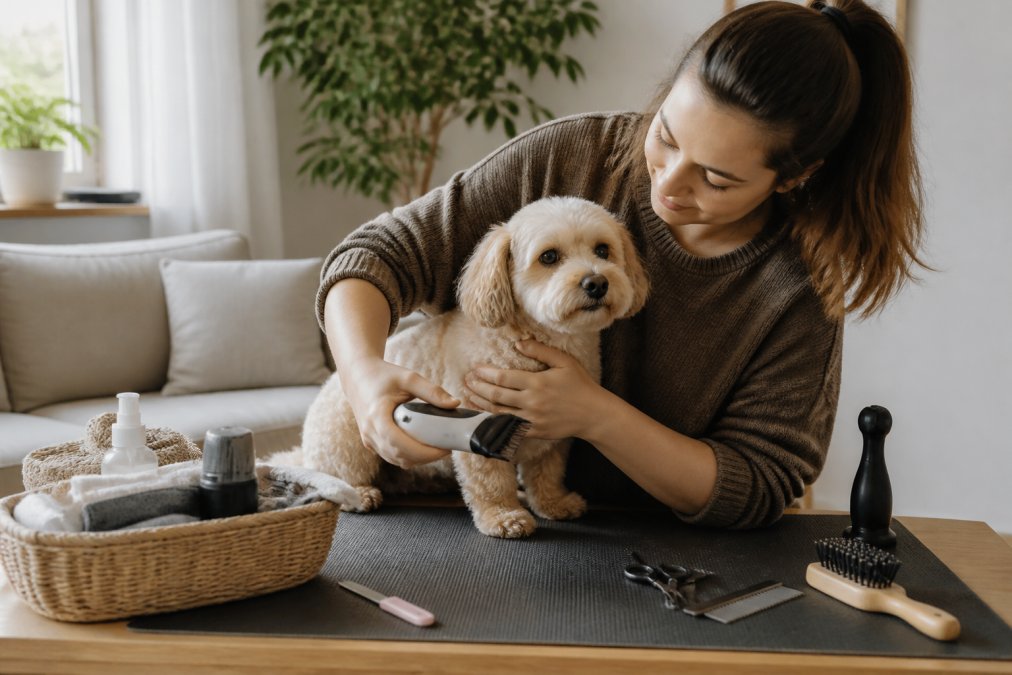
Set the session up before the clippers come out
- Pick the room and close it off. A bathroom or small bedroom with the door shut limits escape routes and echo. Avoid the kitchen, appliance hum stacks on motor noise.
- Non-slip surface first. A towel or rubber mat stops the scrambling that starts when paws slide. Slipping, not the clipper, ends most first sessions early.
- Clip a leash on and loop it, don't hold it tight. A loose loop under one foot gives a safety tether without the tension that reads as restraint.
- Have treats within reach before you switch anything on. Reaching across the dog mid-session restarts the anxiety cycle.
Work in 5-to-10-minute blocks, not one long sitting
A realistic first session is 5 minutes; a dog that has done this a few times can handle 10 to 15 minutes before stress signals appear. Plan three to four short sessions across a week rather than one 40-minute marathon.
Start on the body parts a nervous dog tolerates best
Work in this order, and stop the session wherever your dog's tolerance ends:
- Chest and shoulder, least sensitive, easiest for you to reach, and the dog can see what you are doing.
- Back and flanks, go with the coat direction on the first pass.
- Sanitary area and belly, only after the dog is relaxed on the body.
- Legs and paws, last. Paws are the most defended area on most dogs.
- Face and ears, save for a separate session entirely, and use a narrower blade or a detail trimmer.
Match the clipper setting to the coat, not to your patience
Running a quiet clipper on its lowest speed to "be gentle" backfires on thick coats: the blade stalls, snags, and pulls, and the pulling is what the dog remembers. Use the lowest speed that cuts cleanly in one steady pass. If the motor bogs down, switch to a wider blade, take a shallower pass, or pre-cut mats with scissors.
Troubleshooting the three most common blowups
- Dog bolts when the clipper switches on. You skipped a desensitization stage. Go back to having the clipper on in the same room with the dog loose and unrestrained, and reward calm before attempting contact again.
- Dog is fine until the blade touches skin. This is vibration sensitivity, not noise. You need a model with better dampening, and you should practice contact with the clipper off first.
- Dog was fine for two minutes, then started thrashing. You are past the tolerance window. End on a calm note, even if the cut is half-finished. A half-finished groom you can resume tomorrow beats a finished groom that sets you back a month.
Close every session the same way
Switch the clipper off, set it down out of reach, and reward while the dog is still calm, not after it has scrambled off the table. A consistent end ritual (clipper off, treat, release word, same door out) lets a nervous dog predict the session's end, and predictability is your biggest lever.
Desensitizing Dogs to Grooming Tools
Desensitization is gradually introducing a grooming tool at low intensity until your dog stops reacting. Repeated, non-threatening exposure lowers the startle response over time, the dog learns the sound and vibration predict treats and calm handling, not restraint. Counterconditioning is the companion piece: you are not just reducing fear, you are replacing it with a positive association.
The four stages, with realistic timing
Do not advance until your dog stays relaxed at the current stage for two or three consecutive sessions. A dog that tolerates a stage once is not ready, you want a pattern, not a single good day.
- Stage 1, Clippers off, in the room. Set the clippers on the floor near your dog during normal time together. Reward any calm behavior, including looking at them without reacting. Most dogs clear this in one to three days.
- Stage 2, Clippers on, across the room. Switch them on a few feet away for 30 to 60 seconds, then off. Reward during the noise, not after it stops, so the dog associates the sound itself with the reward. Expect three to five sessions for a sound-sensitive dog.
- Stage 3, Clippers on, contact without cutting. Touch the running clipper (blade side away from skin, or with the guard on) to the shoulder and chest, then reward and switch off. Vibration-sensitive dogs stall here, and it is the stage most owners rush.
- Stage 4, One short clipping pass. A single pass on a low setting over a low-sensitivity area like the shoulder, then stop for the day. Build from one pass to two to a full body area over several sessions.
What "relaxed" actually looks like
Advance only when the dog shows loose posture, a soft or neutral mouth, natural ears, and takes treats normally. A dog that takes treats but holds its breath, freezes, or turns its head away is not relaxed, it is tolerating, and tolerating collapses the moment you add a new variable.
If your dog regresses, go back one stage, don't push forward
Regression is normal, especially after a bad session, a loud noise during grooming, or a long gap between practices. Drop back to the last stage your dog handled calmly, run it for two or three sessions, then try advancing again. Pushing through a regression is the most common way owners undo weeks of progress.
Pair the protocol with the right tool
Desensitization lowers the dog's reaction to a given level of sound and vibration, it does not raise tolerance for a loud clipper. If your dog plateaus at Stage 3 no matter how many sessions you run, the tool is the bottleneck, not the training. That is when a lower-decibel, better-dampened model does more than another week of practice.
Vibration vs. Noise Sensitivity in Dogs
Vibration sensitivity and noise sensitivity are separate problems, and a dog can have one without the other. Most guides miss this: owners buy the quietest clipper they can find, then wonder why their dog still panics.
Breed-Specific Coat Requirements
Coat type decides which clipper you can use, and it overrides quietness as a priority. A quiet clipper that cannot cut through the coat only prolongs the session and raises your dog's stress.
- Double coats (Huskies, Shepherds): need higher motor torque and a detachable blade. The Oster A5 Turbo 2-Speed handles thick coats, though it runs louder than the quiet picks above.
- Curly or continuously growing coats (Poodles, Doodles): benefit from ceramic cutters and guide combs to manage length evenly.
- Short, smooth coats (Beagles, Boxers): a lightweight, low-noise model like the Arco is plenty.
- Sensitive skin: keep blade temperature down with ceramic cutters and lubricate blades between sessions.
Conclusion
Grooming a nervous dog is less about a magic silent tool and more about matching the right low-noise, low-vibration clipper to your dog's coat and triggers. Start with desensitization, keep sessions short, and pick a tool built for anxious pets rather than the loudest bargain on the shelf.
Frequently Asked Questions
What are the quietest pet grooming clippers?
The quietest options in 2026 include the Wahl Professional Animal Arco Cordless Kit, the oneisall Rechargeable Clippers, and the Wahl KM10. These models are designed with low-noise motors and vibration dampening to reduce stress. The Arco is lightweight, while the oneisall offers a budget-friendly alternative. No clipper is completely silent, but these come closest for nervous pets.
How can I groom a nervous dog without causing stress?
Start by introducing the clippers while they are off, letting your dog sniff and get treats. Turn them on briefly and reward calm behavior. Use a quiet, low-vibration clipper and work in short sessions. Pair grooming with positive reinforcement, and try desensitizing dogs to grooming tools gradually. If your dog remains anxious, consult a vet or professional groomer for additional strategies.
Do low-noise clippers sacrifice cutting power?
Not necessarily. Modern low-noise clippers like the Wahl KM10 and Oster A5 Turbo 2-Speed are designed to handle thick coats while minimizing noise and vibration. However, some ultra-quiet models may have slightly less torque for very dense fur. For most breeds, a quality quiet clipper provides sufficient power. Check the motor torque and blade type to ensure it matches your dog's coat.
What features should I look for in clippers for an anxious dog?
Prioritize low decibel rating, vibration dampening, and a lightweight ergonomic grip. Cordless models reduce noise from cords, and ceramic cutters stay cooler. Look for adjustable speeds, detachable blades for easy cleaning, and a rechargeable battery with decent run time. A grooming kit with guide combs helps beginners. Always choose a clipper with a low-noise motor and positive reviews from other pet owners.