

Dog Grooming Table With Arm for Beginners
Table of Contents
- What Beginners Need in a Dog Grooming Table With Arm
- The Best Dog Grooming Table for At-Home Use: What to Compare
- Folding Dog Grooming Table: Portability Versus Stability
- Dog Grooming Table Arm and Noose: Setup and Safe Use
- Dog Grooming Table Alternatives: When a DIY Setup Works
- Common Beginner Mistakes and How to Avoid Them
- Frequently Asked Questions
Last Updated: October 6, 2026
What Beginners Need in a Dog Grooming Table With Arm
A dog grooming table with arm for beginners is a height-adjustable table with a raised arm and restraint loop that holds a pet steady while you trim, brush, and dry. The right table puts your dog at a comfortable working height, keeps them from stepping off mid-trim, and gives you both hands free.
Most at-home groomers quit in the first month because they fight their equipment instead of their dog's coat.
Table Height, Surface, and Weight Capacity
Table height is the single most important spec for a beginner. Too low forces you to bend; too high makes a wiggling dog hard to control.
Tabletop surface matters as much as height. A non-slip surface keeps paws planted. Many groomers add a yoga mat cut to size for extra traction.
Weight capacity should exceed your dog's weight with room to spare. A dog that leans or braces adds load.
Why the Arm and Noose Matter Most
The grooming arm and noose turn a table into a grooming station. The arm is a metal post that rises from the table or clamps to the edge; the grooming noose is a loop that attaches to the arm and rests under your dog's chin or around the neck. The noose is not a leash or punishment restraint, it's a safety stop that keeps a dog from jumping off a raised surface.
The Best Dog Grooming Table for At-Home Use: What to Compare
The best dog grooming table for at-home use matches your dog's size, your storage space, and how often you groom. Compare these five things before you buy:
| Feature | Why It Matters | What to Look For |
|---|---|---|
| Height range | Protects your back and gives you control | Adjustable with locking knobs |
| Tabletop surface | Prevents slipping and anxiety | Non-slip coating or mat-ready |
| Weight capacity | Safety under a leaning dog | Comfortably above your dog's weight |
| Arm and noose | Keeps the dog safely in place | Removable or adjustable arm |
| Foldability | Storage in small homes | Folding legs with secure locks |
A metal desk-style frame tends to hold up better than a wood desk build, but a well-braced wooden top can work for small dogs. The deciding factor is stability, not material.
If you'd rather buy one piece and be done, our Height-Adjustable Pet Grooming Table is built for exactly this job. It rotates a full 360 degrees, includes a storage compartment for tools, and uses an eco-friendly build.
Folding Dog Grooming Table: Portability Versus Stability
A folding dog grooming table trades some rigidity for storage, usually worth it for home groomers, but only if the table still locks solid when open. Folding legs should snap into place with a positive click, not a wobble; a leg that's 90% locked is a table that shifts the moment your dog leans. Portable tables suit anyone who grooms in a bathroom, garage, or laundry room and needs to put the table away between sessions.
Dog Grooming Table Arm and Noose: Setup and Safe Use
Setting up the arm and noose correctly takes about two minutes and prevents most beginner problems:
- Set the table height first, then lock every knob and leg. Adjusting height after clamping the arm can shift the clamp mid-session.
- Attach the table clamp to the edge, checking clamp depth against your tabletop thickness. A clamp too shallow for a thick top will rock; too deep for a thin top will crush the edge.
- Slide the adjustable arm into the clamp and tighten the locking screw hand-tight plus a quarter turn. Over-tightening strips threads and creates wobble.
- Position the restraint loop under the chin, not around the throat, resting at the base of the neck so natural head movement keeps it from riding up.
- Adjust the angle adjustment knob so the arm leans slightly away from your dog, keeping the noose from pulling straight down on the throat.
- Test noose tension with two fingers. Can't fit two fingers, it's too tight; can fit a whole hand, it's too loose to stop a jump.
- Place your dog on the non-slip surface and let them settle with a treat and no tools in your hands.
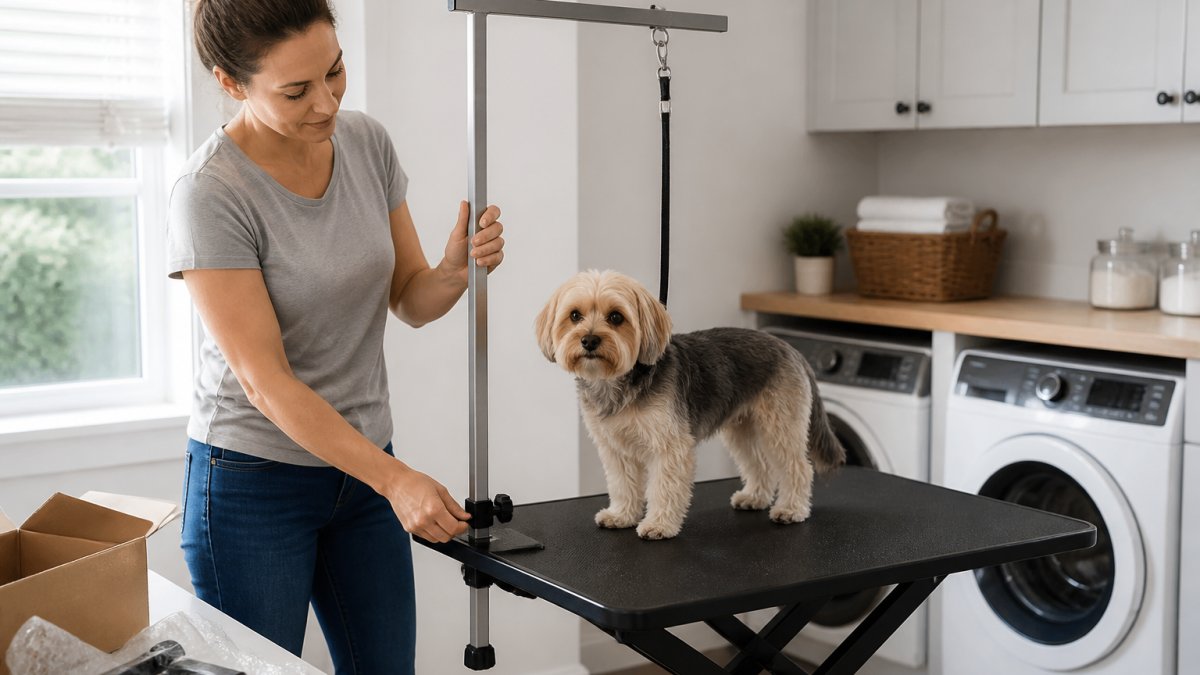
Arm shape: straight post vs. H-shaped
A straight post arm gives you one attachment point and is easier to store. An H-shaped arm gives you two, which helps when you're working one side of the body. For beginners, the H-shape is usually the better first choice because you can move the noose side to side without re-clamping.
Clamp fit and arm flex
A secure attachment at the clamp is where most setups fail, if the clamp shifts, the whole arm shifts with it. Tighten until the table edge shows no movement when you push the arm side to side. Arm flex is the other common failure: a thin arm post on a folding table can bend under a strong dog. Test before you buy by pushing the arm sideways and watching for movement at the clamp and midpoint.
Noose mechanics and safe limits
The noose should allow your dog to stand, sit, and turn their head, but not jump off. If your dog can hop down, the noose is too loose or the arm is positioned wrong. If your dog fights it, fix the tension or arm angle before you blame the dog.
When to stop and reset
Stop the session and reset the setup if any of these happen:
- The dog pants heavily, drools, or tries to lie down repeatedly.
- The noose has ridden up toward the throat.
- The clamp has shifted or the arm has rotated.
A two-minute reset is cheaper than a bad association with grooming. Short, calm sessions with a correct setup beat long sessions with a loose one.
Height-Adjustable Pet Grooming Table →
Dog Grooming Table Alternatives: When a DIY Setup Works
A DIY grooming setup can work for very small dogs, very short sessions, and owners on a tight budget, but it can also be genuinely unsafe. A metal desk or sturdy wood desk at the right height can serve as a grooming surface if you add a non-slip surface and clamp a grooming arm to the edge, provided the desk is heavy enough not to tip.
Matching table dimensions and capacity to your dog
Before you choose any setup, measure your dog nose-to-tail and floor-to-shoulder, then match those numbers to the tabletop:
- Tabletop length: At least your dog's nose-to-tail length plus a few inches so they can turn around without stepping off.
- Tabletop width: At least your dog's shoulder width plus room for their feet to spread when they brace.
- Working height: Your hands should rest comfortably at your dog's back level, for most home groomers, a tabletop that adjusts from roughly knee height to about waist height.
A table sized for a large breed swallows a small dog, and vice versa. Match table dimensions and weight capacity to your actual dog, not to the biggest dog you might own someday.
The honest breakdown
- DIY desk setup: Works for small dogs and light trimming. Requires a heavy desk, a clamp-on arm, and a non-slip mat. No height adjustment.
- Folding grooming table: Best for most beginners. Adjusts, stores flat, and holds a noose safely.
- Fixed grooming table: Best if you have permanent space and a larger dog. Maximum stability.
Troubleshooting wobble, slipping, and anxiety
Most beginner problems trace back to setup, not skill:
- Wobble: Check the leg locks first, then the clamp. A leg that's 90% locked is a table that shifts the moment your dog leans. Re-tighten the clamp at the start of every session.
- Slipping: Add a non-slip surface or a yoga mat cut to size. A dog that slips once will brace for the rest of the session.
- Anxiety: Do a two-minute dry run with no tools in your hands, let the dog stand on the table, get a treat, and step off.
Maintenance, storage, and inspection
A few habits keep a grooming table safe for years:
- Check fasteners and clamp screws before every session. Vibration and repeated setup loosen them.
- Wipe the tabletop after each groom to remove hair and product buildup, which reduces traction.
- Store folding tables with the legs locked closed so the hinges don't take a set.
If your dog has skin irritation, persistent fleas, or coat problems, see a veterinarian rather than working it out at home. Our Pet Grooming & Flea Removal Tool Set is designed for routine coat care and careful removal of visible fleas or debris, but it's not a substitute for veterinary care. Inspect your pet's skin as you work, clean tools after use, and call your vet if problems persist.
Common Beginner Mistakes and How to Avoid Them
Most beginner grooming problems trace back to setup, not skill.
Setting the table too low. You bend, your dog feels you hovering, and both of you get tense.
Over-tightening the noose. A noose that's too tight makes a dog pull backward.
Skipping the clamp check. A loose table clamp is the number one cause of arm flex and wobble.
Grooming too long. Break a full groom into 10-minute sessions and reward your dog between them.
Frequently Asked Questions
What should beginners look for in a dog grooming table with an arm?
Focus on four specs: an adjustable height range you can work at without bending, a non-slip tabletop, a weight capacity above your dog's weight, and a grooming arm with a clamp that tightens firmly. The Height-Adjustable Pet Grooming Table, with its rotating top and storage, covers most beginner needs. Check the clamp depth against your tabletop thickness before buying, and confirm the noose adjusts small enough for your dog's neck.
How do you safely secure a dog on a grooming table?
Fit the noose so two fingers slide between it and your dog's neck, then clip it to the grooming arm. The noose is a restraint loop, not a lifting tool, so never leave a dog hanging or unattended. Keep one hand on your dog at all times, work in short sessions, and stop if your dog panics. A non-slip surface and a stable table reduce slipping, which is a common cause of grooming anxiety in beginners' setups.
Are folding dog grooming tables stable enough for home use?
Yes, when the locking legs engage fully and the table sits on a level floor. Folding tables trade some rigidity for portability, so expect slight arm flex during brushing. Test stability by pressing down on one corner before placing your dog on it. If the table wobbles, tighten the leg locks and check the clamp. For dogs over roughly 50 pounds, a fixed or air-lifting table usually feels steadier.
What can I use instead of a dog grooming table?
A sturdy counter, a nonslip mat on a washing machine, or a low, wide table can work for small dogs and cats if the surface is stable and covered with traction material like a yoga mat. Avoid anything that tips, rolls, or puts your dog at height without a restraint point. DIY alternatives save money but rarely offer an adjustable height or a clamping arm, so they suit light trimming and coat care rather than full grooming sessions.
Grooming at home gets much easier once your station is stable, adjustable, and safe. Pets R Smarter stocks expert-approved grooming gear built around pet comfort, including our height-adjustable rotating table, non-slip surfaces, and coat-care tools that work for beginners. Every order is backed by our Tail Satisfaction Guarantee, so you can try a setup and see how your dog responds. Get started with Pets R Smarter and build a grooming station your dog will actually stand still for.