

How to Calm an Aggressive Dog for Nail Trimming
Table of Contents
- Understanding Fear-Aggression During Nail Trims
- Dog Nail Trimming Desensitization: A Step-by-Step Schedule
- Positive Reinforcement for Dog Grooming: Rewards That Work
- Safe Handling and Restraint Methods for Aggressive Dogs
- Best Dog Nail Clippers for Aggressive Dogs
- When to See a Vet for Dog Nail Trims
- Frequently Asked Questions
Last Updated: September 12, 2026
Understanding Fear-Aggression During Nail Trims
Fear-aggression during nail trims is a defensive response, not dominance. When a dog snaps, growls, or pulls away, it is communicating that handling feels threatening, and the behavior escalates if the dog learns aggression ends the session.
The numbers behind this are sobering. Some dogs show such extreme aggression during nail trims that both veterinary clinics and professional groomers refuse service, according to discussions among pet professionals on Quora's pet care community. That outcome is preventable in most cases, but only when owners treat nail trimming as a training problem rather than a wrestling match. This guide from Pets R Smarter on how to calm an aggressive dog for nail trimming walks through the full protocol: reading your dog's signals, a step-by-step desensitization schedule, reward systems that hold up, safe restraint, and when to bring in a veterinarian instead of pushing forward.
Reading Your Dog's Stress Signals and Body Language
Stress signals appear long before a growl. Lip licking, yawning, whale eye, tucked tail, pinned ears, and a stiffened body mean your dog is approaching its threshold, past which the brain shifts to survival mode, where no treat or command reaches it.
A common mistake is waiting for the growl, which is late-stage communication. Pause and back off at the first lip lick and you teach your dog that calm signals work, reducing the need for aggression. Watch for:
- Turning the head away or refusing to look at the paw
- Sudden freezing mid-touch
- Pulling the paw back before the clipper is even visible
- Panting when the room is cool
Dog Nail Trimming Desensitization: A Step-by-Step Schedule
Dog nail trimming desensitization works by pairing each small step with something good, then repeating it far more times than feels necessary. Petco's desensitization guidance recommends 50 to 100 repetitions of touching the limbs and rewarding with treats before moving to the next stage. That sounds excessive until you watch a dog that was rushed through the steps revert to snapping.
The schedule below is a four-week protocol, but treat the weeks as gates, not deadlines. A dog still pulling its paw away on day 21 stays on that stage, advancing by calendar instead of behavior is the most common reason home desensitization fails.
Week 1, Handling Without Tools
Goal: your dog accepts touch on every paw without flinching. No clippers in the room.
- Sit on the floor at your dog's level, not standing over it.
- Touch one paw for one second, mark ("yes") and treat. Release before the dog pulls away, you want the dog to learn you let go first.
- 50-100 reps per paw weekly, split into 3-5 short sessions per day. Sessions of 60-90 seconds beat one 20-minute marathon.
- Success signal: the dog stops bracing, keeps its head forward, and takes treats with a soft mouth.
Week 2, Hold, Squeeze, and Tap
Goal: tolerate a two-second hold and gentle pressure on each nail.
- Hold the paw for two seconds, treat, release. Build to five seconds only if the dog stays relaxed.
- Add a light squeeze of each toe, mimicking clipper pressure.
- Introduce the clipper as a prop: sniff, feed, put away. Repeat 10-20 times per session.
- Success signal: no paw withdrawal when the clipper is picked up.
Week 3, Clipper Contact and Sound
Goal: the clipper touches nails without a cut.
- Tap the side of the clipper against a nail, treat, release. Work one nail at a time.
- For grinders, run the motor in another room first, then in the same room at a distance, then near the paw. An electric toothbrush is a common low-cost stand-in for vibration and sound before the real dremel comes out, a technique shared among owners in a Facebook dog training group.
- Success signal: the dog looks at the clipper and then back at you, not away.
Week 4, First Cuts and Paw-by-Paw Build
Goal: one clean nail, then one paw per session.
- Clip one nail, then immediately deliver a jackpot, several high-value treats in a row, not one.
- Cap the session at one nail for the first three sessions even if the dog is doing well. Ending early is the reward.
- Build to one full paw per session over 5-10 sessions before attempting a second paw in one sitting.
- Success signal: the dog recovers within a minute and still takes treats after the clip.
| Stage | What You Do | Repetitions | Success Signal |
|---|---|---|---|
| 1 | Touch one paw, treat, release | 50-100 | Dog stays relaxed |
| 2 | Hold paw 2 seconds, treat | 50-100 | No pulling away |
| 3 | Tap nail with clipper, treat | 50-100 | Clipper ignored |
| 4 | Clip one nail, jackpot treat | 10-20 | Dog recovers fast |
| 5 | Clip one full paw per session | 5-10 | No avoidance |
Tailoring the Plan to the Type of Aggression
Knowing how to calm an aggressive dog for nail trimming is not one schedule that fits every dog. Triggers and safe handling differ by aggression type, and matching your approach to the driver separates a plan that works from one that stalls.
- Fear-based aggression. The dog retreats rather than advances: tucked tail, ears back, whale eye, backing into a corner. Slow the schedule and add distance. Work at the dog's chosen distance, and let the dog approach the clipper rather than bringing it to the dog.
- Resource-guarding aggression. The dog guards the paw, a person, or the space. Do not reach in, trade instead: offer a high-value item for the paw, and never remove the guarded thing by force. A second person feeding from a distance often defuses this faster than working alone.
- Pain-based aggression. The dog reacts only when a specific paw or leg is touched, or harder on one side. This is a veterinary problem first. Nail trimming will not fix it, and pushing through can turn a treatable injury into chronic handling aversion. Book an exam before resuming training.
When to Stop and Reset
If your dog growls, snaps, or freezes, the session is over. Do not finish the nail or push through "just one more." End calmly, put the tools away, and drop back one full stage next session. Two consecutive failures at the same stage means it is too big, split it into smaller steps rather than repeating it.
Positive Reinforcement for Dog Grooming: Rewards That Work
Positive reinforcement for dog grooming only works when the reward outranks the fear. Kibble will not cut it for a frightened dog. Use high-value food, boiled chicken, cheese, or liver, reserved only for nail sessions so it stays special.
Timing matters more than quantity. The treat must land within one second of the calm behavior, not after the nail is clipped. Reward the stillness, not the finished nail.
Using Distraction Tools: Lick Mats and Treat Trays
Distraction tools keep the dog's brain occupied while your hands work. A lick mat smeared with soft food, or a treat tray loaded with small rewards, shifts attention away from the paw. This approach is widely used by owners managing mild anxiety, per Whitestone Community Forum discussions. It is not a substitute for desensitization, but it lowers arousal enough to make each session productive.
Safe Handling and Restraint Methods for Aggressive Dogs
Safe restraint means the minimum contact needed to keep both of you unhurt, never pinning or flipping a dog onto its back. For most dogs, a non-slip mat, a second person feeding treats, and a gentle body block against your leg is enough. A compression wrap can help some dogs settle.
Muzzle training belongs here. A basket muzzle fitted weeks in advance and introduced with treats lets you trim nails safely without adding stress. For hand protection, lightweight gloves help, but know their limits: the Protective Pet Handling Gloves sold at Pets R Smarter create a barrier against ordinary scratches and light contact, but are not bite-proof and cannot prevent every injury.
Best Dog Nail Clippers for Aggressive Dogs
The best dog nail clippers for aggressive dogs are quiet, sharp, and correctly sized, a dull blade crushes the nail, creating pain and confirming every fear your dog has. Two formats work well:
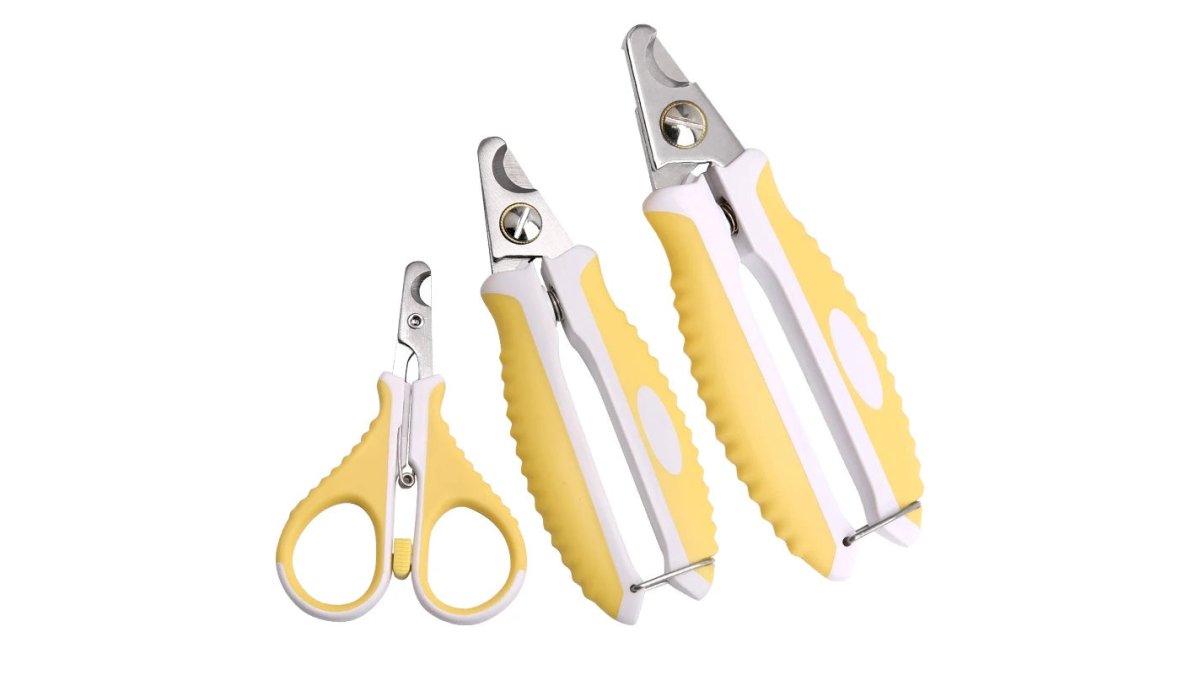
- Scissor-style clippers for thick nails and quick single cuts. The Dog & Cat Nail Clipper at $12.50 uses stainless steel blades that cut cleanly, which matters when your dog only tolerates one nail per session.
- Nail grinders for gradual shortening, though the motor noise requires separate desensitization first.
Keep styptic powder on hand for nicks. Cutting the quick once can set training back weeks, so clip small slivers and stop while your dog is calm. The Silicone Slow-Feeding Lick Mat at $14.75 holds attention during the trim, and the Mini Dog Treat Training Bag at $9.99 keeps rewards within reach so you never break contact to dig for a treat.
When to See a Vet for Dog Nail Trims
Most articles stop at "ask your vet," leaving owners without what they need: what a vet can do, what the options are, and how to use a visit as a bridge rather than a replacement for training.
Red Flags That Mean Stop Home Trimming
Book a veterinary appointment and pause home trimming if any of the following apply:
- Your dog has drawn blood on a person or itself during a trim attempt.
- The dog shows aggression outside of nail trims, at the vet, at the groomer, or during routine handling at home.
- One paw or leg is consistently more sensitive than the others, or the dog limps or shifts weight off a limb.
- Nails are curling into the pad, have torn, or are embedded.
- Every session ends in a bite attempt, even after weeks of desensitization work.
What a Veterinarian Can Actually Do
A vet visit for nail-trim aggression is a diagnostic and management appointment, not just a trim. It typically includes:
- Pain assessment. Nail or paw pain, arthritis, and orthopedic issues can all make handling feel threatening. Treating the underlying pain often resolves the aggression without any behavior work.
- Medical screening. Thyroid dysfunction, orthopedic disease, and chronic pain are common contributors to sudden-onset handling aggression in older dogs.
- Behavioral assessment. A veterinarian can distinguish fear-based, pain-based, and anxiety-driven aggression and refer you to a veterinary behaviorist if the case is complex.
- A one-time chemical bridge. For dogs that cannot be safely handled, a vet can prescribe short-acting sedation or anti-anxiety medication so the nails can be trimmed without a struggle while you continue training at home.
Sedation and Anti-Anxiety Options
Owners often resist medication because it feels like giving up. It is not. Sedation is a bridge: it prevents the quick from overgrowing and nails from curling into the pad while behavior work continues, and it removes the rehearsal of aggression that worsens the problem each failed attempt.
Common options a veterinarian may discuss include:
- Short-acting injectable sedation given in-clinic for a single trim when the dog cannot be safely handled at all.
- Oral anti-anxiety medication given at home before a visit, often paired with a calm environment and a low-stimulation waiting area.
- Daily anti-anxiety medication for dogs whose fear generalizes beyond nail trims, prescribed alongside a behavior modification plan.
Medication is not a substitute for desensitization. It is what makes desensitization possible for dogs that have already learned that handling predicts pain. Ask your vet which option fits your dog's age, health status, and bite history, and ask what to watch for afterward.
How to Work With Your Vet as a Team
Bring a written log: how many sessions you have run, what stage you reached, what triggered the last failure, and your dog's recovery time. Vets and veterinary behaviorists tailor a plan far more precisely when they can see the pattern rather than guess at it.
Ask specifically:
- Is there a medical driver for this behavior?
- Is a one-time sedation appropriate while we train, and what is the protocol?
- Should we see a veterinary behaviorist, and can you refer us?
- What is a realistic timeline for returning to home trims?
If your dog has drawn blood or shows aggression outside of nail trims, stop home trimming and book a veterinary consultation. Behavior that generalizes signals a medical or behavioral issue beyond grooming. Sedation is a bridge, not a failure, it protects your dog's nails and your training progress while the underlying problem is addressed.
Frequently Asked Questions
What should I do if my dog is aggressive when I try to trim their nails?
Stop immediately and do not force the trim. Forcing it will make your dog more fearful and could lead to a bite. Instead, start a desensitization plan: touch your dog's paws briefly, reward with treats, and repeat 50 to 100 times before moving to the next step. Use a lick mat with peanut butter or cream cheese to distract your dog during short sessions. If aggression is severe, consult your veterinarian or a certified behaviorist before trying again.
How do I desensitize my dog to nail trimming?
Break the process into small steps. First, touch your dog's paw for one second and reward. Repeat 50 to 100 times until your dog is relaxed. Then introduce the clipper by showing it and rewarding. Next, touch the clipper to a nail without clipping. Finally, clip one nail and reward heavily. Keep sessions under five minutes and use high-value treats. This method, called dog nail trimming desensitization, builds trust over weeks, not days. Patience is key for long-term success.
Is it better to use a nail grinder or clippers for aggressive dogs?
It depends on your dog's sensitivity. Clippers are faster and require less handling time, which can be better for dogs who panic. Grinders are quieter and smoother but the noise and vibration may scare some dogs. If you choose a grinder, first desensitize your dog to the sound by using an electric toothbrush. For either tool, pair with positive reinforcement for dog grooming. The best dog nail clippers for aggressive dogs have safety guards and sharp blades to minimize pressure and risk of cutting the quick.
When should I see a vet for dog nail trims?
See a vet if your dog has drawn blood, bitten, or shows extreme panic (screaming, snapping) despite training. Also, if nails are severely overgrown and curling into the paw, a vet can trim them safely. Some dogs need sedation or anti-anxiety medication, which only a vet can prescribe. If you're unsure, call your vet for guidance.