

How to Choose the Right Dog Clipper Blade Size
Table of Contents
- Why Blade Size Matters for Your Dog's Comfort and Safety
- Understanding Dog Clipper Blade Numbers: Higher Means Shorter
- Dog Clipper Blade Size Chart: Matching Numbers to Coat Length
- How to Use Clipper Guard Combs for Longer Cuts
- Best Clipper Blades for Matted Fur: Skip-Tooth vs. Finish Blades
- Blade Maintenance, Heat Management, and Sanitization
- Troubleshooting Uneven Cuts and Blade Compatibility
- Frequently Asked Questions
Last Updated: September 10, 2026
Why Blade Size Matters for Your Dog's Comfort and Safety
Choosing the wrong dog clipper blade is the fastest way to turn a routine trim into a stressful ordeal for both you and your pet. Blade size determines how close the cutter reaches the skin, and getting it wrong causes nicks, razor burn, and a dog that fights the clippers every time they appear. The good news: matching blade to coat is a learnable skill, and it takes about ten minutes to understand.
The stakes go beyond appearance. A blade that cuts too close on thin-skinned areas like the belly, armpits, and groin can irritate or cut. A blade that's too long leaves the coat uneven and traps heat. Below, we'll show you exactly how to read blade numbers, match them to coat length, and handle the tricky cases like matting and guard combs.
Understanding Dog Clipper Blade Numbers: Higher Means Shorter
Dog clipper blade numbers work on an inverse scale: the higher the number, the shorter the cut. A #40 blade cuts closest to the skin, while a #3 blade leaves the most length (primpawsgroomingacademy.com). This backward logic confuses nearly every first-time groomer, and it's the single biggest source of blade-selection mistakes.
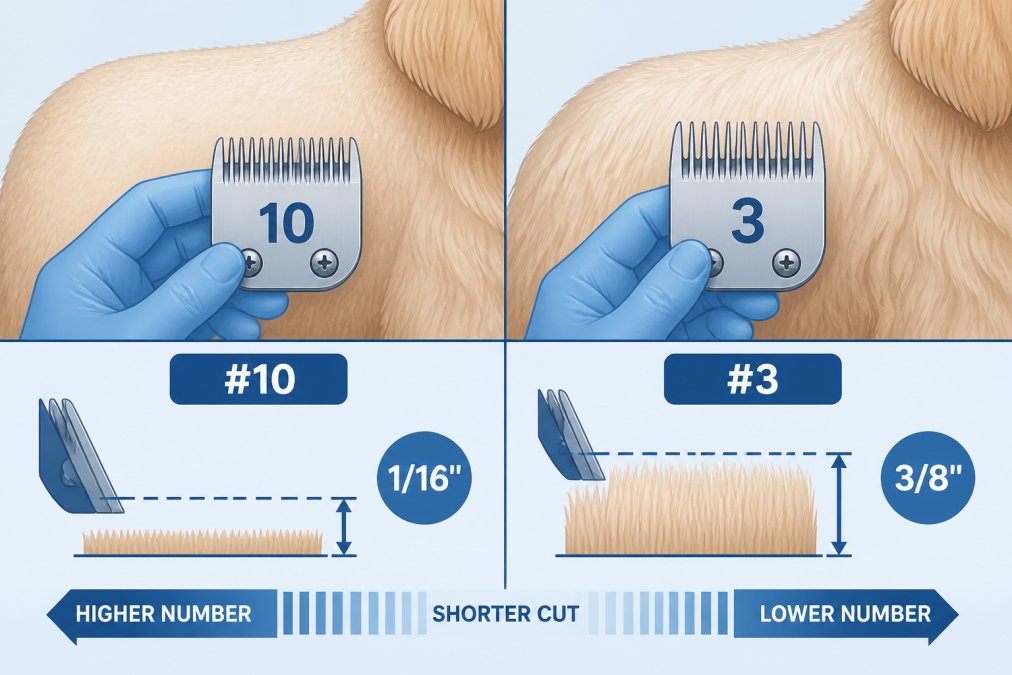
Industry consensus confirms this inverse relationship: higher numbers like #40 cut closer to the skin, while lower numbers like #3 leave longer hair, according to Primpaws Grooming Academy's blade guide. Once that clicks, the rest of the chart makes sense.
The Inverse Rule: #40 Cuts Closest, #3 Leaves Length
Think of the number as "how many passes to skin." A #40 surgical blade is used for precise, close work like paw pads and sanitary trims. A #3 or #4 blade is a finishing length for breeds that keep a longer coat. Most at-home grooming happens in the middle: #7F, #10, and #15 cover the majority of full-body clips.
Dog Clipper Blade Size Chart: Matching Numbers to Coat Length
Use the chart below as your starting point, then adjust for coat density and your dog's skin sensitivity. The dog clipper blade size chart is the reference most groomers keep taped inside a cabinet door.
| Blade Number | Cut Length | Best For |
|---|---|---|
| #3, #4 | Longest | Double coats, breed-standard trims |
| #5, #7F | Medium | General body clips, thicker coats |
| #10 | Short | Standard full-body clip, most breeds |
| #15 | Shorter | Dense coats, closer body work |
| #30, #40 | Closest | Paw pads, sanitary, surgical prep |
Quick Reference: Common Blade Numbers and Their Uses
A #10 is the workhorse for most full-body clips on average coats. Reach for a #7F when you want a slightly longer finish that hides uneven passes. Save #30 and #40 for the delicate spots where precision matters more than speed. If your dog has a thick undercoat, drop one number shorter than you think you need, because dense coat holds length.
How to Use Clipper Guard Combs for Longer Cuts
Clip-on guard combs snap over a base blade to add length, and many groomers prefer them over high-number fixed blades for longer styles. This is where a common piece of advice gets it backwards: beginners are often told to buy a rack of fixed blades, when a single #10 blade plus a set of guard combs covers far more ground.
Here's how to use clipper guard combs without the guesswork:
- Start with a #10 or #30 blade as the base.
- Snap the guard comb on until it clicks, then tug gently to confirm it's seated.
- Clip with the hair growth direction for a smooth finish, against it for a tighter cut.
- Move up one comb size if the result looks shorter than expected.
Best Clipper Blades for Matted Fur: Skip-Tooth vs. Finish Blades
The best clipper blades for matted fur are skip-tooth blades for the first pass, followed by a finish blade once the tangles are cleared. Skip-tooth cutters have gaps between teeth that let them slice through mats and detangle without jamming or pulling skin.
Skip-Tooth Blades: Your First Pass Through Tangles
A skip-tooth blade feeds matted and dirty coat through the gaps instead of choking on it. Use it to break up matting before you attempt any smooth finish. Go slowly, keep the blade flat, and never force it through a solid mat; if the blade stalls, the coat is too tight and needs detangling first.
Finish Blades: Smooth Results After Detangling
Once the mats are gone, switch to a finish blade for an even, polished clip. Finish blades have a full set of teeth for a clean pass with no track marks. Skipping this second step leaves a choppy coat that shows every skip-tooth line.
Blade Maintenance, Heat Management, and Sanitization
Blade care is where home grooming quietly succeeds or fails. A dull, hot, or dirty blade drags, burns, and cuts unevenly, no matter how good your technique is. The blade, not the clipper motor, is often the limiting factor in a clean clip, so treat maintenance as part of the grooming session, not an afterthought.
Why Blades Get Hot (and How to Stop It)
Heat is friction. The cutter oscillates against the comb at high speed, and every pass generates friction that transfers into the metal. The longer you run a blade without a break, the more heat builds, and a hot blade is the top cause of clipper burn on the belly, armpits, and groin, where skin is thin and folds trap heat.
A practical heat-management routine:
- Start cool. Run the clipper for 30 seconds before touching your dog so you know the baseline temperature.
- Work in short passes. Clip for 2-3 minutes, then set the clipper down and let the blade rest.
- Test on your wrist. Touch the flat of the blade to the inside of your wrist every few minutes. If it is uncomfortable to hold there, it is too hot for your dog's skin.
- Swap, don't push. Keep a second, cool blade on hand and rotate. A spare blade costs less than a vet visit for clipper burn.
- Cool correctly. Use a purpose-made coolant spray, or let the blade air-cool on a metal surface. Do not dunk a hot blade in cold water, rapid temperature change can warp the cutter and shorten blade life.
Oil, Cleaning, and Sharpening Cadence
- Oil before every session. A drop on the cutter and the rail reduces drag, which reduces heat. Oil more often on thick or dirty coats.
- Brush out hair between passes. Packed hair insulates the blade and forces it to work harder.
- Deep-clean weekly (or after every few dogs). Remove the blade, brush out trapped hair, and wipe the comb and cutter with a blade-safe cleaner. Avoid soaking the whole blade in water; moisture in the drive area causes rust.
- Sharpen or replace when it pulls. A sharp blade cuts; a dull blade pulls, snags, and leaves track marks. If you feel resistance or see the blade riding over the coat instead of through it, it is done.
Sanitization Between Dogs (and After Skin Contact)
If you groom more than one dog, or your dog has a skin condition, hot spot, or open nick, sanitize the blade between uses. Cross-contamination is a real risk: ringworm, bacterial dermatitis, and mites can transfer on a blade that touched an affected dog.
A simple protocol:
- Remove the blade and brush out all hair.
- Wipe the comb and cutter with a disinfectant labeled for grooming tools, or use a 1:10 bleach-to-water wipe followed by a clean-water wipe and full dry.
- Oil the blade before it goes back on the clipper.
- Never share an unsanitized blade between dogs, and never use the same blade on a dog with a known skin infection and a healthy dog without disinfecting in between.
Storage
Store blades oiled, dry, and in a case or rack so the teeth do not knock against each other. Chipped or bent teeth cause the cutter to skip and leave lines, the same symptom as a dull blade, but no amount of sharpening fixes it.
Troubleshooting Uneven Cuts and Blade Compatibility
Uneven cuts almost always trace back to one of four causes: a dull blade, a worn blade drive, a mismatched blade and clipper, or inconsistent technique. Before you blame your hands, check the hardware. Work through this diagnostic in order, it saves you from replacing parts that were never the problem.
Step 1: Is the Blade Dull?
A dull blade pulls hair instead of cutting it. Signs: the clipper slows in thick coat, the dog flinches, and you see track marks or a choppy finish even when your passes overlap. Fix: sharpen or replace the blade. If a fresh blade cuts cleanly, dullness was the cause.
Step 2: Is the Blade Drive Worn?
The blade drive (also called the drive lever or hinge) is the small part that transfers motor motion to the cutter. When it wears, the cutter wobbles instead of oscillating cleanly, and the blade skips or leaves lines. Signs: the blade rattles, cuts unevenly on one side, or stalls under light pressure. Fix: replace the drive lever, it is an inexpensive part and a common failure point on clippers that have seen a lot of use.
Step 3: Is the Blade Compatible With Your Clipper?
Blade compatibility trips up more buyers than any other factor. There are three main systems, and they do not interchange:
- A5-style detachable blades. The most common system for professional and prosumer clippers. The blade snaps onto a hinged socket and is driven by a lever. If your clipper accepts A5 blades, you can mix and match sizes from any brand that makes A5-compatible blades.
- Snap-on blades. A separate category, often found on consumer clippers. These blades snap directly onto the clipper head and are not interchangeable with A5 blades, even if they look similar.
- Adjustable blades. Built into the clipper head and adjusted with a lever or dial rather than swapped. You cannot change the blade size, you change the cutting height, so guard combs become the only way to vary length.
Before buying any blade, confirm your clipper's blade system. The model number and manual will state it, and if you are unsure, the shape of the blade socket is the tell: A5 blades have a distinctive hinge and drive slot, while snap-on blades have a simpler clip. Buying the wrong system is the single most common reason a new blade "doesn't fit."
Step 4: Is Your Technique Causing the Lines?
If the hardware checks out, the issue is technique. Track marks come from:
- Passing against the grain on a finish pass. Clip with the hair growth direction for a smooth finish; against it for a tighter cut. Mixing directions mid-body leaves visible lines.
- Not overlapping enough. Each pass should overlap the previous one by about half the blade width.
- Moving too fast. Slow, steady passes let the blade cut cleanly. Rushing leaves ridges.
- Letting the blade ride up. Keep the blade flat against the skin. Tipping the cutting edge lifts it and leaves a longer strip.
When to Stop and Reset
If you have checked the blade, the drive, the compatibility, and your technique and the cut is still uneven, stop. Put the dog down, take a break, and start fresh with a clean, cool, sharp blade. Pushing through a bad cut makes it worse and stresses the dog. A grooming table like the Height-Adjustable Pet Grooming Table keeps your dog at a comfortable working height so your passes stay level and your blade stays flat, one of the most common causes of uneven results is simply working at an awkward angle.
Frequently Asked Questions
What is the best size clipper blade to trim my dog's hair?
The best dog clipper blade size depends on your goal. For a close summer cut or sanitary trim, a #10 blade works well. For general body grooming with some length left, a #4 or #5 blade is a good choice. If your dog has a thick double coat, start with a #7 or #10 and follow with a guard comb. Always match the blade to your dog's coat type and the look you want.
Does a #7 or #10 blade cut shorter?
A #10 blade cuts shorter than a #7. Blade numbers work inversely to hair length: higher numbers leave less hair. A #10 blade leaves about 1.5mm of coat, while a #7 leaves roughly 3mm. For a very close trim, such as a poodle's face or paws, use a #10. For a slightly longer body clip, a #7 gives you a bit more margin.
How do I know which blade size is safe for my dog's skin?
Blades that cut very close, like #30 or #40, can irritate or nick sensitive skin. For most at-home grooming, a #10 is the closest safe option for body work. Always use a guard comb if you want to avoid skin contact. Check your dog's skin for lumps, moles, or irritation before clipping, and use a light touch. If your dog has thin or sensitive skin, stick to #7 or higher.
Can I use a #10 blade under a guard comb?
Yes, a #10 blade is often used under snap-on guard combs to achieve longer lengths while keeping a smooth finish. The guard comb lifts the hair away from the skin, so the #10 does not cut as close. This setup works well for dogs with medium to long coats. Make sure the guard comb is securely attached and matches your blade size for best results.