

How to Desensitize a Puppy to Grooming Tools
Table of Contents
- Why Your Puppy Needs Grooming Tool Training Early
- Puppy Grooming Training Steps: The Sound-to-Contact Progression
- How to Get a Puppy Used to Clippers Without Fear
- Desensitize Dog to Nail Grinder and Nail Trimmer Sounds
- What to Do When Your Puppy Is Afraid of Grooming Tools
- How to Desensitize a Puppy to Grooming Tools: Tool-by-Tool Plan
- Conclusion
- Frequently Asked Questions
Last Updated: October 12, 2026
Why Your Puppy Needs Grooming Tool Training Early
Learning how to desensitize puppy to grooming tools starts long before the first haircut, with a clipper that is off, a brush on the floor, and a handful of tiny treats.
Puppies go through a window in their first few months when new sights, sounds, and touches feel less threatening. That window does not stay open forever.
The mistake most owners make is treating "desensitization" and "counterconditioning" as the same thing.
This guide covers a sound-to-contact progression, a tool-by-tool plan, and clear signs for when to push forward or pause.
Puppy Grooming Training Steps: The Sound-to-Contact Progression
Puppy grooming training steps follow one rule: sound first, sight second, touch last. A puppy can handle a noise from across the room long before a vibrating blade against its belly.
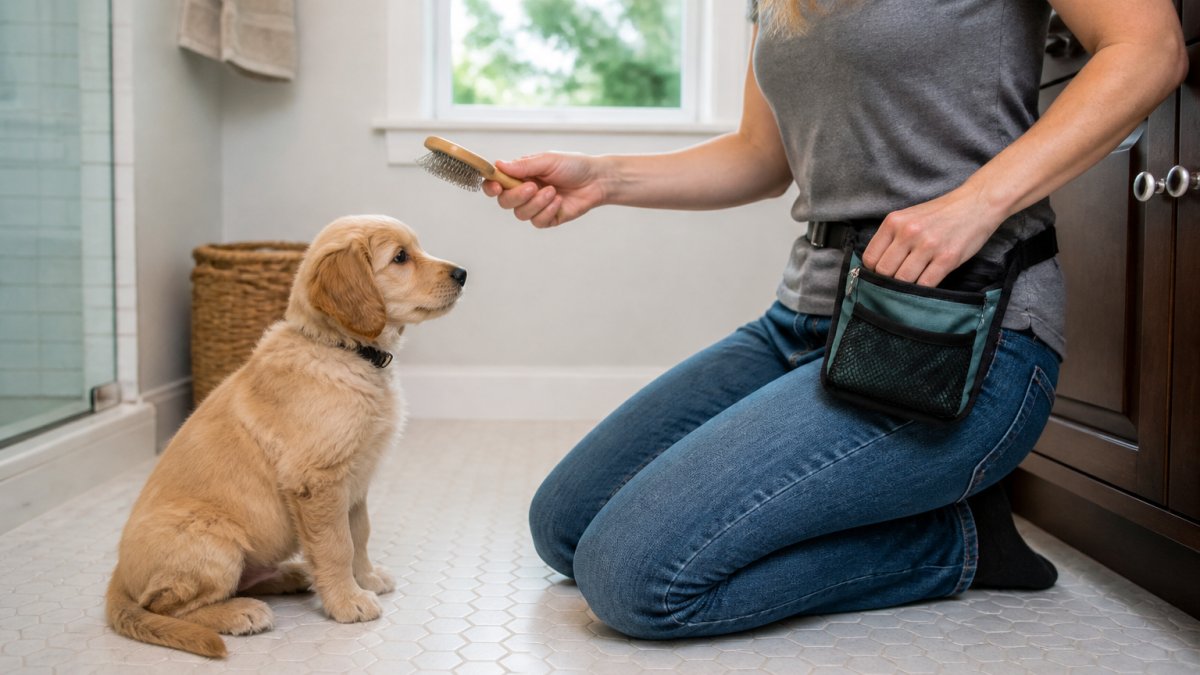
Step 1: Let Your Puppy Investigate the Tool
Set the tool on the floor, turned off. Let your puppy sniff it, paw it, and walk away. Drop a treat near it. Pick it up and put it down. Repeat for a few days.
Do not hold the tool against your puppy yet. Curiosity comes before contact.
Step 2: Introduce the Sound Before the Tool Touches Fur
Turn the clipper on across the room, feed treats, turn it off, that is the whole session. Over several days, move closer, then turn it on near your puppy's body without touching. This is the step most owners skip, and the one that prevents the meltdown later.
Step 3: Pair Contact With Treats and End on a Win
Touch the back of the handle to your puppy's shoulder, then feed. Work up to one stroke with the brush, then feed, and stop while your puppy is still relaxed. Pushing for "one more stroke" when your puppy is already pulling away teaches that pulling away does not work, end early instead.
How to Get a Puppy Used to Clippers Without Fear
Getting a puppy used to clippers means separating the three things that scare puppies: the sound, the vibration, and the blade near sensitive skin.
Never run clippers over the face, ears, or paws during early training.
The Pet Grooming & Flea Removal Tool Set gives you several small tools to practice handling with, so your puppy learns that "tool time" is normal before the real clipper shows up.
Desensitize Dog to Nail Grinder and Nail Trimmer Sounds
To desensitize dog to nail grinder sounds, treat the grinder as a sound problem first and a nail problem second, that hum is often the part puppies hate most.
Our Dog & Cat Nail Clipper is stainless steel and works well for the one-nail-at-a-time approach. Trying to finish all four paws in one sitting is how nail trims become a fight.
What to Do When Your Puppy Is Afraid of Grooming Tools
If your puppy is afraid of grooming tools, drop back to the last step your puppy handled calmly and rebuild. Fear does not respond to repetition of the scary thing, it responds to slower steps and better rewards.
Watch for these stress signals during every session:
- Lip licking when no food is present
- Yawning outside of nap time
- Turning the head away or freezing
- Tucking the tail or lowering the body
- Pulling a paw back before you touch it
- Sudden disengagement, sniffing the floor, scratching, or walking off mid-session
One signal means slow down and make the next repetition easier. Two or more means stop for today and resume tomorrow at a lower step.
Match the Response to the Behavior
Puppies show fear in different ways, and each pattern needs a different fix:
- Fleeing or hiding. The current step is too big. Shorten the distance, lower the sound, or go back to the tool on the floor. Do not chase or corner, that turns mild worry into a handling problem.
- Freezing. Freezing is not calm; a stiff, still puppy is often more stressed than a wiggly one. Stop, remove the tool, and reward the moment your puppy relaxes. Freezing is the pattern most likely to tip into a snap.
- Growling. Growling is information, not defiance. Never punish it, a puppy that learns growling gets corrected may skip the warning and bite. End the session, note the trigger, and rebuild two steps back.
- Mouthing or biting the tool. Redirect to a treat or chew, end the session, and treat the next attempt as a brand-new introduction. If your puppy bites skin, stop home practice and get hands-on help.
When to Bring In a Professional
Most puppies work through mild grooming worry with patient home practice. Reach out to a veterinarian or qualified force-free behavior professional if you see any of these:
Slicker Grooming Brush for Dogs & Cats →
- Your puppy panics, screaming, thrashing, or losing bladder control, at the sight or sound of a tool
- Growling, snapping, or biting during handling, even at low intensity
- Sudden fear of a tool your puppy previously accepted, which can point to pain, injury, or a skin issue
- Visible skin problems, redness, scabs, hair loss, or sensitivity to touch
- No progress after several weeks of consistent, short, reward-based sessions
A veterinarian can rule out pain, nail-bed injuries, ear infections, or skin conditions that make grooming genuinely uncomfortable.
Higher-value treats help at every step. Kibble works for easy steps. For hard steps, use small pieces of chicken or cheese. The Mini Dog Treat Training Bag keeps those high-value rewards within reach so you are not fumbling in a drawer mid-session.
How to Desensitize a Puppy to Grooming Tools: Tool-by-Tool Plan
How to desensitize puppy to grooming tools comes down to matching the tool to the right order of exposure. Some tools are easy, some need weeks. The plan below gives you a starting order, a realistic timeline, and criteria for moving forward or pausing.
The Order to Introduce Tools
Work through this sequence. Do not start a new tool until your puppy is calm on the one before it.
| Order | Tool | First Exposure | Progress To | Watch For |
|---|---|---|---|---|
| 1 | Slicker brush | Sniff, then one stroke | Full body brushing | Scratching at the bristles |
| 2 | Comb | Sniff, then one pass | Full body combing | Pulling away from tangles |
| 3 | Deshedding brush | Sight and sound only | Short strokes on back | Pulling away from pressure |
| 4 | Nail clipper | Handle near paw | One toenail per session | Paw tucking |
| 5 | Nail grinder | Sound across room | One nail, split second | Head turning at the hum |
| 6 | Clipper | Off, then on nearby | Flat side on shoulder | Freezing at vibration |
| 7 | Blow dryer | Low setting, far away | Air on back, not face | Startling at the noise |
Session Length, Frequency, and Age
Keep sessions to one to three minutes for puppies under four months, up to five minutes for older puppies. Two to five short sessions a day beat one long one, aim for five or six days a week rather than a weekend cram.
A realistic timeline for a puppy starting at eight to twelve weeks:
- Weeks 1-2: Tool on the floor, sniffing, treats. No contact.
- Weeks 2-4: Sound at a distance, then nearby. Still no contact.
- Weeks 4-6: One stroke or one second of contact per session.
- Weeks 6-10: Build to full brushing and one toenail per session.
- Weeks 10+: Add clippers, grinder, and dryer one at a time.
Expect variability. A puppy that breezes through brushing may stall on the grinder for a month. That is normal, not failure.
Criteria for Progressing or Pausing
Advance to the next step only when your puppy shows all three of these in the current step:
- Relaxed body, soft eyes, loose tail, weight settled rather than braced.
- Takes treats readily, a stressed puppy often stops eating.
- Stays in place, no pulling away, no freezing, no paw tucking.
Pause and repeat the current step if you see one stress signal. Drop back a step if you see two or more, or if your puppy avoids the training area. Never increase intensity and duration in the same session, change one variable at a time.
Pairing Tools With Rewards
Pair each tool with a food reward delivered within one second of calm behavior, consistency beats duration every time. For brushing, start with the Slicker Grooming Brush for Dogs & Cats, a simple plastic tool for short and long coats. For heavy shedders, the Dog & Cat Deshedding Grooming Brush is a step up once your puppy accepts light pressure.
For bath-time and grooming-table practice, spread soft food on a Silicone Slow-Feeding Lick Mat. The textured surface keeps your puppy licking while you handle paws and ears. It is one of the simplest ways to buy yourself two calm minutes.
Conclusion
Every puppy is different, and some need more time than others. The process itself is simple: sound before sight, sight before touch, and treats at every step.
Pets R Smarter carries the tools that make this training easier, including our Slicker Grooming Brush, Nail Clipper, and Silicone Training Treat Pouch.
Get started with Pets R Smarter and build grooming sessions your puppy actually looks forward to.
Frequently Asked Questions
How long does it take to desensitize a puppy to grooming?
Most puppies need several weeks of short, daily sessions before they accept grooming tools without stress. Start with five-minute sessions and repeat the same step until your puppy stays relaxed, then move to the next step. Some puppies progress in two weeks; others need two months. The pace depends on your puppy's temperament and how consistently you practice. Rushing the process usually backfires and creates lasting fear.
Should I use treats when introducing grooming tools?
Yes. Pair every tool with a food reward so your puppy links the brush or clipper to something good. Use tiny, soft treats or kibble and deliver them the moment the tool touches your puppy, not after. This is called counterconditioning, and it works best when the reward comes during the experience, not just at the end. A silicone treat pouch worn at your waist keeps rewards within reach so you never break the flow.
What should I do if my puppy is scared of grooming tools?
Stop and back up to an easier step. If your puppy flinches at the sight of clippers, put the clippers on the floor across the room and reward calm behavior from a distance. Move closer only when your puppy stays relaxed. Never force a tool onto a frightened puppy, because that builds avoidance and bite risk. If fear persists after several weeks of gentle work, ask your veterinarian about a referral to a certified behavior consultant.
When should I start grooming training with my puppy?
Start as soon as you bring your puppy home, usually around eight weeks of age. Young puppies accept new experiences more easily than adult dogs. Begin with handling exercises like touching paws, ears, and toes, then add tools one at a time. Keep sessions to two or three minutes at first and reward heavily. Early, positive exposure makes future nail trims, brushing, and bath time far easier for both of you.