

Training Your Puppy for Grooming at Home: 6-Week Plan
Table of Contents
- Why Training Your Puppy for Grooming at Home Matters
- A 6-Week Plan for How to Get a Puppy Used to Grooming
- Puppy Paw Handling Training: Steps for Nails and Paw Touch
- How to Brush a Puppy: Coat Types and Tool Choices
- How to Bathe a Puppy Without Fear
- Troubleshooting Common Puppy Grooming Challenges
- Conclusion: Building a Lifelong Grooming Routine
- Frequently Asked Questions
Last Updated: October 8, 2026
Why Training Your Puppy for Grooming at Home Matters
Training your puppy for grooming at home means teaching a young dog to accept handling, brushing, bathing, and nail care through short, calm, reward-based sessions.
That window closes faster than most owners expect: a puppy who learns touch predicts treats carries that calm into every future groom, and one who learns touch predicts struggle carries that too.
Grooming is also basic health care, not just cosmetics (Grooming-Related Concerns Among Companion Animals). peer-reviewed research on grooming-related concerns in companion animals describes grooming as an essential health-maintenance activity tied to the welfare of companion animals.
Below, we break down a 6-week plan you can start this week, plus the tools and safety limits that matter most.
A 6-Week Plan for How to Get a Puppy Used to Grooming
Getting a puppy used to grooming works best as a slow build. Each week adds one new sensation while repeating what your puppy already accepts. Keep sessions under five minutes and stop while your puppy is still relaxed.
| Week | Focus | Daily Practice | Watch For |
|---|---|---|---|
| 1 | Handling | Touch paws, ears, tail for 10 seconds | Pulling away, freezing |
| 2 | Brushing | Soft brush on back and sides | Trying to mouth the brush |
| 3 | Bath prep | Warm water on paws, damp cloth | Shaking off, backing away |
| 4 | Full bath | Wet, lather, rinse, towel dry | Whining, scrambling |
| 5 | Nails | Touch clippers to nails, no cut | Tucking paws under |
| 6 | Sounds and clippers | Turn clippers on nearby, then touch | Startling at the buzz |
Pair every step with treats, praise, and a calm voice. One short daily session beats one long weekly one.
Puppy Paw Handling Training: Steps for Nails and Paw Touch
Paw handling is the hardest skill for most owners and the one that unlocks nail trims.
Work through these steps:
- Touch the paw, treat, release.
- Hold the paw for three seconds, treat, release.
- Press the pad so the nail extends, treat, release.
- Tap the nail with closed clippers, treat, release.
- Trim one nail, treat, take a break.
- Trim one paw per session, then stop.
A common mistake is finishing all four paws in one sitting, that is how nail trims become wrestling matches.
Our Dog & Cat Nail Clipper has stainless steel blades and a compact grip, which helps when you are working with a small, wiggly paw.
How to Brush a Puppy: Coat Types and Tool Choices
The right brush depends on your puppy's coat, not their breed label. Two puppies of the same breed can carry different coat densities, and a doodle mix may inherit anything from a flat, wavy coat to a tight curl.
Match the tool to the coat:
- Short, smooth coats (beagle, boxer, most terrier crosses): a rubber curry or soft bristle brush lifts loose hair and spreads skin oils. Once a week is usually enough, more during seasonal shedding.
- Medium coats (cocker spaniel, sheltie, most spaniel mixes): a slicker brush reaches the undercoat without scratching skin. Two to three times a week.
- Long or curly coats (poodle, bichon, doodle mixes): a slicker plus a metal comb, daily. The comb is the real test, if it cannot pass through the coat from skin to tip, you have a tangle forming.
- Double coats (husky, German shepherd, most spitz types): a slicker plus an undercoat rake, several times a week. Never shave a double coat to reduce shedding; it can grow back unevenly and disrupt the coat's ability to insulate against heat and cold.
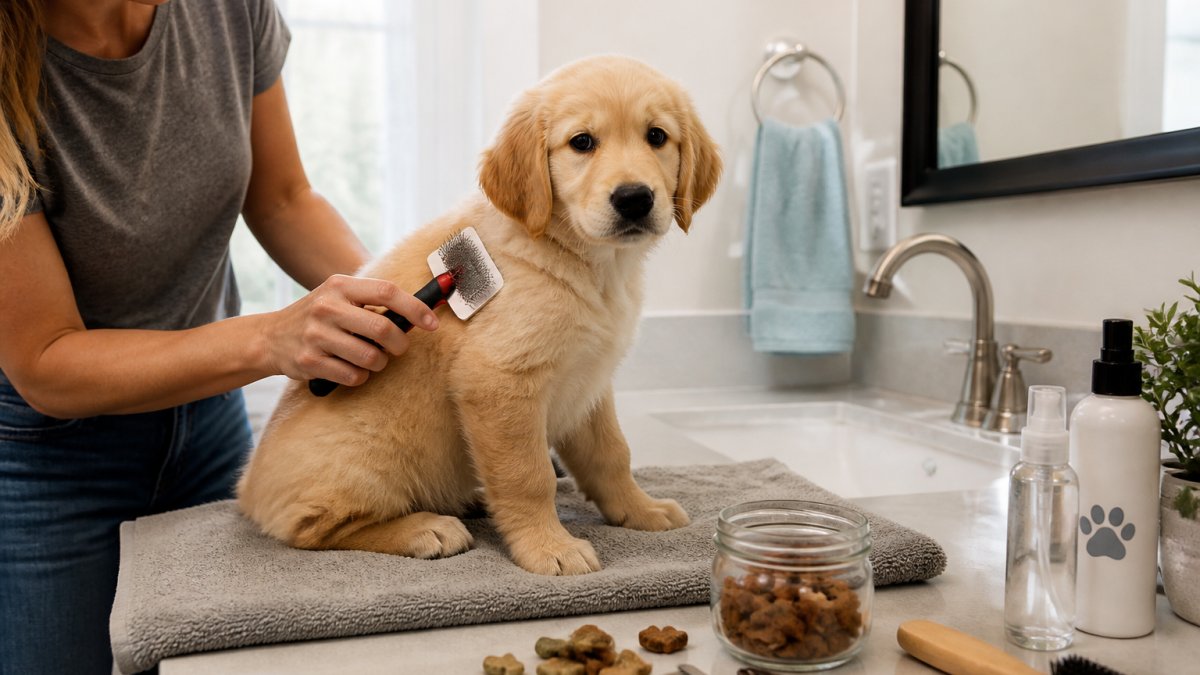
Our Slicker Grooming Brush for Dogs & Cats is built for routine at-home coat care and works for both short and long hair.
How each tool actually works
A slicker brush has fine wire pins set at an angle.
A metal comb is a diagnostic tool as much as a grooming one. Run it through the coat after brushing.
An undercoat rake has short teeth that reach the dense layer under the topcoat. Use it in the direction of growth with gentle pressure, and stop when it pulls instead of gliding.
Brushing order and reading your puppy
Brush in the direction the coat grows. Start on the back, where most puppies are least sensitive, then move to the sides, chest, legs, and finally the belly and tail. Keep sessions to a few minutes and reward often.
Watch for these signals that you are moving too fast:
- Lip licking, yawning, or looking away, early stress signals.
- Freezing or stiffening under the brush.
- Trying to mouth the brush or the hand holding it.
- Sudden scratching or biting at the brushed area, which can mean the pins are digging in.
If you see any of these, stop brushing that area, reward, and end the session on a calm note. Come back to it the next day with lighter pressure.
Mats are a welfare issue, not a styling one
What most guides miss is that matting is a welfare issue, not a styling one. guidance on grooming risks when owners lack training or proper equipment notes that at-home grooming can carry real risks when owners use unsuitable tools or miss subtle health issues.
Slicker Grooming Brush for Dogs & Cats →
If you find a tight mat, do not cut it out with scissors, skin sits close under mats and tents upward as they tighten, so it is easy to slice.
How to Bathe a Puppy Without Fear
A first bath should feel boring, not dramatic. Use warm water, a non-slip mat, and a pitcher or low-pressure spray.
Set the room up before your puppy comes in, towel, shampoo, and treats within reach. A puppy left alone in a tub, even for a second, learns to panic.
Follow this order:
- Brush out loose hair first.
- Place a non-slip mat in the tub.
- Wet the body, avoiding the head.
- Lather and rinse until the water runs clear.
- Towel dry, then air dry in a warm room.
Keep the Mini Dog Treat Training Bag nearby so you can reward calm behavior without leaving your puppy.
Troubleshooting Common Puppy Grooming Challenges
Most grooming problems trace back to going too fast. If your puppy fights the brush, you moved to a sensitive area too soon; if they bolt at the tub, the last bath ended badly. Slow down and rebuild one step at a time.
Common problems and fixes:
- Biting the brush: switch to a softer brush, shorten sessions to under two minutes, and reward while the brush is still moving rather than after it stops.
- Hiding at bath time: run the tub with no water in it, just treats. Let your puppy stand in the dry tub for a few days before water enters the picture.
- Fear of clippers: turn them on across the room, then move closer over days. Pair the sound with treats before the clippers ever touch fur.
- Nail panic: go back to paw touching for a week. Do not pick up the clippers until the paw touch is boring again.
For puppies with very short attention spans, split one task across two sessions in a day rather than pushing through a single long one.
Know the stop signals
A puppy cannot say "that hurts" or "I need a break," so read the body. Stop immediately if you see any of these:
- Freezing or going stiff under your hands or a tool.
- Tucking the tail, flattening the ears, or turning the head away repeatedly.
- Whale eye, the whites of the eyes showing because the puppy is looking away from you.
- Drooling, panting heavily, or trembling when the room is not warm.
A puppy that snaps during grooming is not being dominant or stubborn. They are telling you the handling has crossed a line. Pushing through a stress signal teaches your dog that grooming is a fight, and that lesson sticks far longer than the nail you were trying to trim.
Overstimulation versus fear
These look similar but need different responses. Overstimulation is a wound-up puppy, wiggly, mouthy, grabbing at the brush, unable to settle; the fix is a shorter session, a quieter room, and a break.
If you are not sure which one you are seeing, end the session. You lose nothing by stopping early, and you protect the association between grooming and good things.
When to call a professional
Some situations are beyond what at-home training can safely address. Talk to your veterinarian or a qualified force-free trainer or groomer if:
- Your puppy shows real distress, shaking, drooling, snapping, or trying to bite, that does not improve after several weeks of slow, reward-based sessions.
- You find skin that is red, broken, oozing, or has an odor under the coat.
- Your puppy limps, favors a paw, or yelps when a nail is touched. This can point to an injury or an ingrown nail that needs veterinary attention.
- Your puppy has a mat that is tight against the skin, or a coat that has not been brushed out in weeks.
- Your puppy has a medical condition, recent surgery, or is on medication that affects their skin or coat.
A veterinarian can rule out pain or a medical cause behind grooming resistance, a force-free trainer can coach you through handling exercises in person, and a professional groomer can reset a coat that has gotten away from you. None of these is a failure, they are the right tool when the job is bigger than a brush and a bag of treats.
Conclusion: Building a Lifelong Grooming Routine
A puppy who learns to accept grooming at home carries that skill for life.
The tools matter as much as the training. At Pets R Smarter, every product is chosen with your pet's comfort and safety in mind, from our stainless steel nail clipper to our slicker brush.
Get started with Pets R Smarter and build a grooming routine your puppy actually tolerates.
Frequently Asked Questions
At what age should I start training my puppy for grooming at home?
Start as soon as you bring your puppy home, usually around 8 to 12 weeks. Short, positive sessions of one to two minutes work well at this age. Early handling helps your puppy accept grooming as part of a normal routine. Keep the first few weeks focused on gentle touch and treats before introducing tools like brushes or clippers.
How often should I practice grooming with my puppy at home?
Aim for short daily sessions of two to five minutes rather than one long weekly session. Daily brushing with a soft brush keeps the coat free of tangles and builds trust. Rotate focus areas: one day paws, the next day ears or face. Weekly practice on nail handling and bath preparation rounds out the routine without overwhelming your puppy.
What should I do if my puppy is scared of grooming?
Stop the session and let your puppy settle. Pair each small step, like touching a paw or showing the brush, with a treat and praise. Keep sessions under two minutes and use a calm voice. If your puppy shows stress signals like lip licking, yawning, or pulling away, back off and try again the next day. A slicker brush or a soft cloth can help ease the introduction to tools.
When should I take my puppy to a professional groomer for the first time?
Most veterinarians recommend a first professional grooming visit after your puppy has completed its initial vaccination series, often around 12 to 16 weeks. Before that, at-home practice with handling, brushing, and bath preparation makes the visit less stressful. A short meet-and-greet with the groomer can help your puppy adjust to the new environment and sounds.